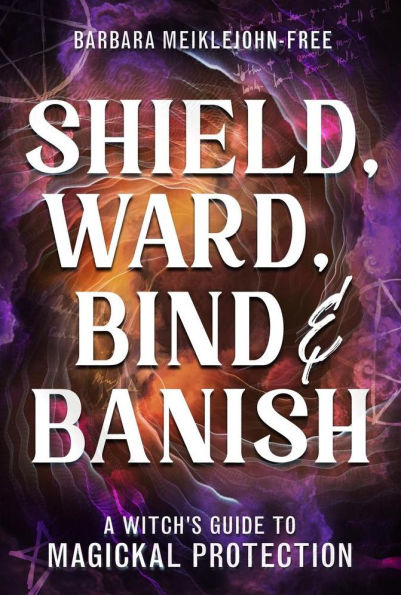
I was expecting this book to come out of more traditional Scottish witchcraft but it is far more eclectic. Barbara Meiklejohn-Free assumed the mantle of the Highland Seer, a title that has been around for a few centuries, and was mostly recently held by a famous Scottish psychic who was an early mentor to her. The author talks of growing up in a family with traditional Scottish witches. She also mentions bits about spiritual adventures around the globe. The local part of the book shows up in the local plants and herbs and some folk magic traditions. The eclecticism is noted when she calls on Heka, an Egyptian god of magick and healing, or Artemis, or Odin. Perhaps I read too much into her title of highland seer so my expectations were off. As an American I was wondering what is the difference between English and Scottish witchcraft but the book doesn't consider this topic. The spells use classic, poetic phrases.
Meiklejohn-Free covers a lot of ground. In Part One, the author explains that magickal protection comes in various forms. Arcane protection wards off harmful forces, psychic protection against psychic attacks, personal and energetic protection for the body and spirit. She's very clear about her belief that intention makes the power of magick. She also stresses that positivity is important as "to remain positive is to protect your power." Sometimes I felt that her positive talk and spells sounded more like self-affirmations: "I see myself clearly, empowered and whole. The light of protection shines through me. No shadow shall touch me; no ill shall pass. By my power and the stars, I am forever guarded."
The eclectic nature of her path shines through as she discusses angels and devas, ancestral guides, daemons, dragons and egregores, amongst others. Fetch spirits is a term I expect is more common in the UK, described as spirits that accompany the witch during astral travel and magickal workings. Under Gods and Goddesses, she lists Egyptian, Greek, Irish and Norse deities. The ritual to invoke deities for magickal protection calls out, "By Hekate's light and Thor's might, by Brigid's flame and Anubis's sight. I call upon you, gods and guides, to protect my spirit and stand by my side." She also brings up Jinn, servitors, shadow guardians, thoughtforms, The Watchers and other entities briefly.
The section on nature and its spirits, discusses plant magic and the traditional uses of trees, influenced by old Celtic lore. The book moves from plants to elementals and then to the fae. The chapter on talismans covers uses of gems and stones, various types of salt, bones, graveyard dirt, brimstone, and water from snow versus stream versus stormwater, metals and kitchen herbs.
Part Two The Work starts with infusing one's intent and magickal purpose into items such as poppets. A chapter on seals and symbols and sigils details how to create your own. In spirit of the home, Meiklejohn-Free talks about her personal rituals to connect with her house's spirit. If you are familiar with the way Marie Kondo connects with a house, you will have a feel already for what this means. "Remember that a threshold is a living thing, a space of constant motion and energy exchange. Every time you cross it, you interact with the magick you've woven there. Please take a movement to pause as you step across it, whether entering or leaving. Feel the protective energy that surrounds you and honour the boundary that keeps your inner sanctuary safe from the chaos beyond." The ritual for Guarding your Threshold uses a broom or besom, blackthorn salt, a protective token such as a horseshoe, a pentacle and common kitchen herbs. This again struck me as more Scottish than other parts of the book. I don't even know if I can get blackthorn salt in my area. Ritual saining, using smoke from burned herbs, utilizes heather, rowan, and juniper. This is another moment where I wouldn't know where to get the heather and rowan and it struck me as more local to where the author lives.
I was surprised by the Ritual Protection against Electrical and Radiation Stress. Mind over matter? If there are serious issues, I would start with distancing myself from the source. In energy of Forgotten Places, residual energies such as buildings over battlegrounds, are addressed. This is something I think you hear more about the further east you go, whether it's from the Midwest to Virginia, or from the East coast to the UK, the older the standing buildings, the more this seems to matter. It's less common for American writers to get into geopathic stress. She uses a crystal in the ritual. I like that she brings up these topics but my sense of it is that there are places where people are better off not living and if you find yourself in one, a ritual like this is more of a band aid than a permanent fix.
Shielding out the world handles all those outside influences that creep into your personal space. With online bullying banishing and empowerment in the digital space, the modern world extension past our personal boundaries, is put in check. Shielding for sensitive people gets into more shamanic work with cutting cords. Dream protection goes over methods to clear the energy of your bedroom, how sleeping in different cardinal directions brings different energies, and methods to dream without trouble. Meiklejohn-Free states that witches in dreams may be wandering with their astral body and this is not without risk. She talks about dream guardians and familiars as protectors. The traditions of witchcraft seem to come closest to shamanistic practices in her description of the dream space and protection from the beings in it.
The final chapters are the most advanced, dealing with baneful magic, curses, and The shadow Mire, an egregore that comprises much negativity.
Shield, Ward, Bind & Banish is a good title for getting the idea of protection magic across to the reader. The book skims many more topics than title would hint at. The book does gloss over many topics quickly. The most advanced topics are found in the last chapters. For someone in a coven, protection magick often takes place in ritual with the draw down of various Gods. This book is designed to provide protection magick spells and rituals that neither require a coven nor a specific pantheon. Some of it falls firmly into the folk magic category, some is influenced by the 19th century exploratory occultists who were fascinated with grimoires and Egypt. The topics covered will be familiar to those who are experienced or well read. The strength of the book is that the author is good with her words. Readers will gain a good overview of the kinds of protective magick in practice. North American readers may take an interest in what is the same and different across the pond.
~review by Elsie Smyte
Author: Barbara Meiklejohn-Free
Llewellyn Worldwide, 2026
pp. 312, $17.99