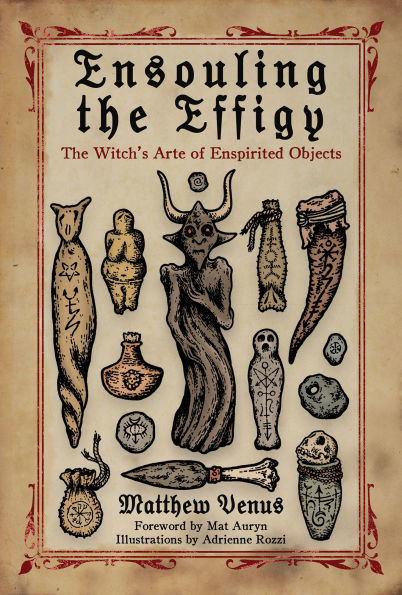
I’ve been a Witch for more than forty years and I’ve done a lot of things but works like this make me feel like I’ve just been dabbling all this time. Ensouling the Effigy is a tremendously thorough and complete manual on all aspects of making, empowering, and working with material objects as spirit vessels in witchcraft.
He begins with foundation ideas and the practices needed to both understand and work with the spirits in the first section of the book – discussing animism, consciousness and spirits. He moves then to the ideas of a witch – our self-identity, the identities in the larger cultures, powers and personas and a clear definition as a traditional witch that he will rely on through the rest of the book.
A valuable chapter of practical exercises and discussion of ideas of the Otherworld follows. Then he moves to a clear and thorough discussion of the nature, language, and types of spirits that one may encounter, with several exercises on developing the senses needed to work with fetches, to establish a protective spirit for venturing into otherworldly realms. A discussion of conjuring, invocation, possession, and negotiation of pacts with spirits, together with excellent advice on discernment and cautions in your agreements is the last chapter in this section.
Only after this substantial preliminary preparatory work – remembering that in magickal work your principal tool is your self and if you are not a proper person, properly prepared you will be incapable of doing anything worthwhile – does he begin his discussion of creating magical objects, effigies.
The second section begins with a chapter of history and archaeology describing the earliest effigies. He then briefly discusses and defines fetishes, bottle spells, magica materia, working with masks, skulls, grimoires, magical tools, shrines, and other objects that may be used in this work.
In chapter eight he gets down to some practical details, discussing materials and methods for crafting effigies in some detail – different types of clay, dough, wax, cloth and thread, dyes, animal skins, fillings, the use of spit or other bodily fluid, and a range of other materials, each of which has different associations and pulls in different spiritual force. He ends with an exercise on crafting a clay effigy.
A thorough discussion of the materials that might be used, why particular materials would be chosen, their associations and power, collecting them, conjuring power into and out of them, understanding what and whom you are using (in an animist outlook, each thing chosen has an associated spirit personality and it is advisable to develop reciprocal relationships and alliances with many of them). He grounds this discussion in praxis – exercises on finding materials to work with in a sacred journey, on crafting ensouled stuffing for spirit vessels, on preparing the heart-stone (the central ‘home’ of the spirit that will be put into an effigy). He has detailed instructions on preparation for entering cemeteries to gather goofer dust for this work, and questions to consider when working with bones or other animal parts.
By chapter ten, having gathered all the materials needed, carefully formed your intention and contacted and made agreements with the spirits whose aid you will be calling upon, it is time to commence the main work. The vessel has been made, given a ritual death or exorcism, entombed for a period, resurrected, reborn, given the breath of life, named and the spirit’s role, function, and limitations are clearly stated. Then the vessel is enshrined, cared for, and worked with as agreed to. Again, his detailed instructions, as well as specific exercises on raising up personal power, pouring the breath of life through you into the effigy, walk you through this whole process.
Chapter eleven, a short and less detailed one, deals with poppet magic, both positive and baneful, with a complete ritual for the working.
Chapter twelve deals with caring for and cohabiting with enspirited objects, in particular looking after the spirit vessels that you made and upholding any agreements that you made with them, making offerings, and, when necessary, releasing the spirit and oneself from the relationship. There is also a rite of exorcism and banishing, both of a specific spirit and a general one.
And finally, Venus has appendices with incense recipes, sigils, a selection of ritual scripts, and some planetary alignments, colour associations, and other useful details.
In each section of this excellent work Venus prepares the reader thoroughly, defines concepts clearly, explains each step and walks the reader through preparatory exercises before moving on. He frequently offers both cautions and advice on deepening the connections with spirits to make the practice more effective. Although there is a great deal of valuable information presented, a lot of details to take in, it is clearly presented, logically structured, and at no point did I feel either confused, overwhelmed, or condescended to. I strongly suggest reading the entire book, doing the exercises, and not cherry-picking the specific detail that suits you – your work will be both more grounded and powerful and safer.
A splendid book, a valuable addition to my reference library.
~review by Samuel Wagar
Author: Matthew Venus
Crossed Crow Books, 2025
420 pg. Paperback £20 / $37 Can / $27 US