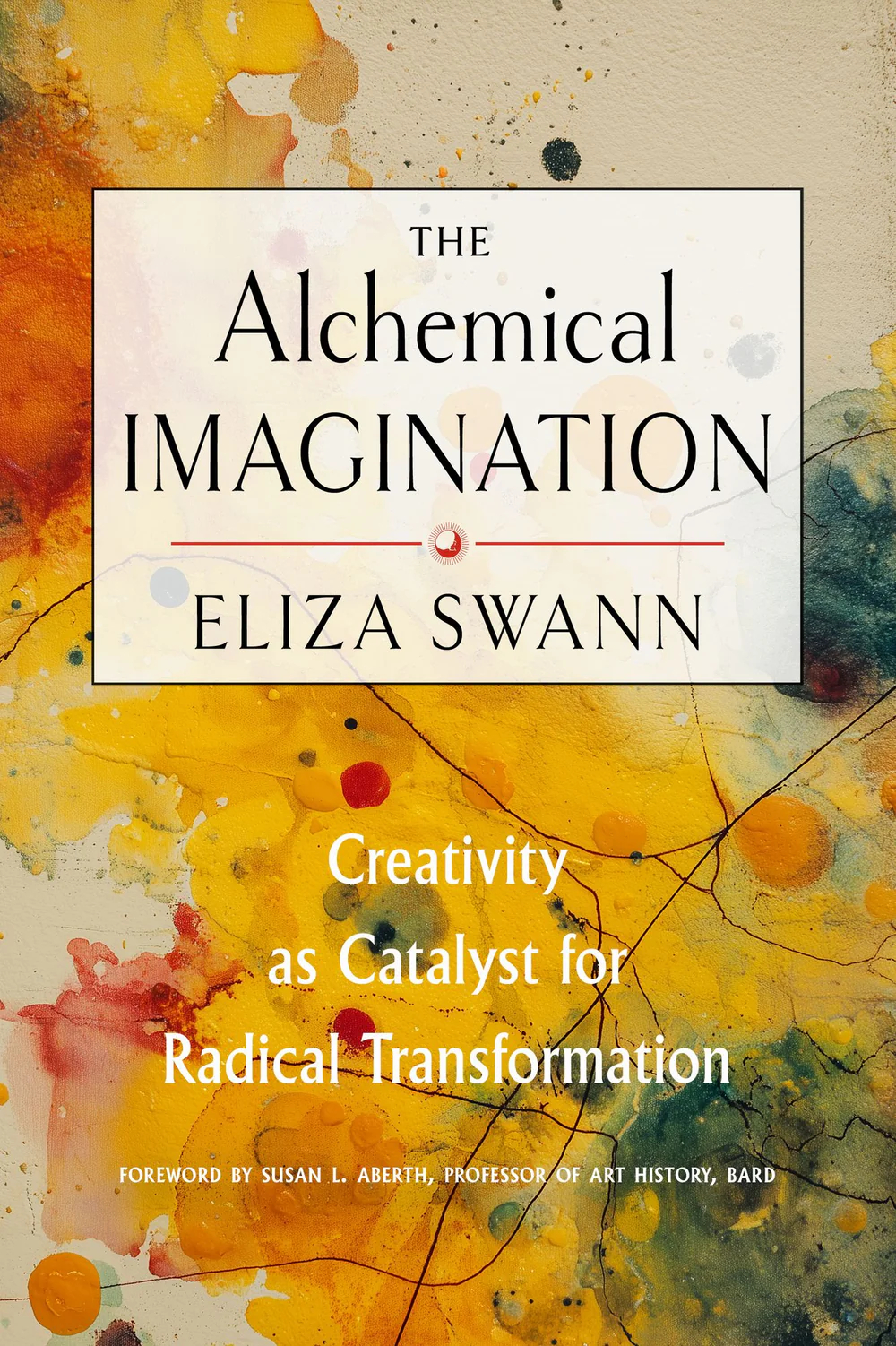
Author Eliza Swann opens this book with a couple of stories. At a party for faculty at an art college, someone asked what Swann teaches, and when they answered, “critical studies and alchemy,” the “room erupted in laughter as though these two things were an oxymoron.” Another time, at a birthday party, someone thought it’d be funny to tease, “You teach them to make gold? Will you teach me?”
We’re a few centuries past the times when the educated classes knew that art and alchemy have long been companions; when alchemy was part of the academic canon. That was before, as Swann writes, “science disposed of mystery in favor of mechanical philosophy.”
Eliza Swann is an interdisciplinary artist and educator, a long-time teacher of the mystical dimensions of art, and the author of an earlier book, The Anatomy of the Aura. This new book, The Alchemical Imagination, draws on Swann’s ten years of teaching, including a popular art and alchemy class.
What’s unique about this book is that it addresses the subject of alchemy from the perspective of artistic, creative processes. Swann blends history, philosophy, and technique with a sequenced set of exercises for readers to work through, beginning with the instruction to assemble “a beautiful new notebook,” pens and pencils, time, and “dedication to incorporating prayer and contemplation into your creative practices –these are key tools.”
“Alchemy,” Swann writes, “views spiritual and material realities as deeply interconnected, allowing alchemists to approach problems as radically interdisciplinary thinkers.” Swann presents no “single, fixed definition of alchemy,” which is part of the book’s point. Alchemy, as presented here, isn’t one thing. It is “a series of linguistic, artistic, and experiential explorations.”
There are some definitions, though. “Alchemy is a study of the natural sciences, but it also incorporates poetry, emotion, intuition, and spiritual discipline to generate both insight and material results.” In classical European alchemical philosophy, “transformation unfolds in three distinct phases: nigredo, albedo, and rubedo.” The book follows the three-phase sequence, each a “crucial step in personal and creative development.”
Nigredo, the first phase, is like the dark night of the soul, when processes dissolve and fall apart. “In the internal realm, this signifies the unraveling of old identities and outdated beliefs.” At the phase of abedo, the “phase of lunar illumination…what has been broken down is filtered and clarified.” Finally, rubedo initiates a breakthrough. “The dawning light reveals the world afresh, and we can start to apply insights we’ve gained outwardly.” The rubedo phase involves “the ultimate creative act: the creation of the Philosopher’s Stone.”
This is the Holy Grail of alchemy, the Philosopher’s Stone, “a legendary substance believed to hold the key to transforming base metals into gold, a precious metal that resists rust, tarnish, and corrosion.” This substance was/is used for healing via powerful elixirs. It is “both a symbolic concept and a tangible object that can be created” through alchemy, but only “when the alchemist has attained a level of inner knowing that supports its formation.”
The creation of the Philosopher’s Stone has often been called the Great Work or the Magnum Opus. Swann refers throughout the book to a major contributor in the history of alchemy, George Ripley, whose 1591 book The Compound of Alchymy describes the stages that Swann draws on to “unlock our own artistic Great Work.”
I can scarcely do justice to the sheer volume of technique and inspiration packed into The Alchemical Imagination. As the book proceeds, Swann does define alchemy: it is “fundamentally the study and practice of transformation, grounded in the principles that govern change.” One of these is the principle of correspondences, captured in the well-known phrase, As above, so below.
The book is organized along the lines of the three phases of transformation: nigredo, abedo, and rubedo, with short chapters on a pantheon of luminaries. Not just historical figures such as Robert Fludd, the 17th century English physician and alchemist, but artists, poets, and philosophers from other centuries and places on the planet. There’s an entry about the 17th century Japanese poet Matsuo Basho – and Swann offers an exercise on writing a poem. There’s another on the 1970s and 1980s Cuban American artista Ana Mendieta who used her own body in art installations.
There are chapters for each of the five visible planets (Mercury, Venus, Mars, Jupiter, Saturn) and the Sun and Moon, with representative artists and philosophers for each of these planetary spheres, weaving history, myth, and contemporary art, plus exercises for readers to experiment with. For example, in the chapter about Mercury and the myth of the Greek god Hermes, Swann recommends an apt practice: Place on one’s desk a photo of an artist one loves and admires and make offerings to that artist, asking for their support.
As Swann explains, “the secret processes by which alchemists sought to create the Philosopher’s Stone were structured into conceptual frameworks known as ladders,” consisting of seven, twelve, or fifteen rungs. George Ripley outlined twelve of these ladders as distinct stages in the production of the Philosopher’s Stone: calcination, solution, separation, conjunction, putrefaction, congelation, cibation, sublimation, fermentation, exaltation, multiplication and, finally, projection. Nearly half of The Alchemical Imagination consists of Swann’s examination of Ripley’s twelve stages through their historical applications, associated literary and symbolic imagery, and significance in traditional alchemy and contemporary artistic work. Swan offers creative and meditation exercises for each of the stages and recommends spending about a month per stage, “allowing a year for deep immersion into this transformative work.”
Just as alchemy was for the ancients, what Swann offers is a Great Work for a lifetime, or even lifetimes beyond this one. Swann ends with an imagined scene in the future, year 3060, when wars, greed and a thing called patriarchy have given way to a world “not built by domination or hatred but with holographic spirals of care and attention that continuously bloom [and]…. [where ] You, the alchemist, are one of the beings who imagined us here.”
~review by: Sara R. Diamond
Author: Eliza Swann
Weiser Books, 2026
240 pages, $21.95