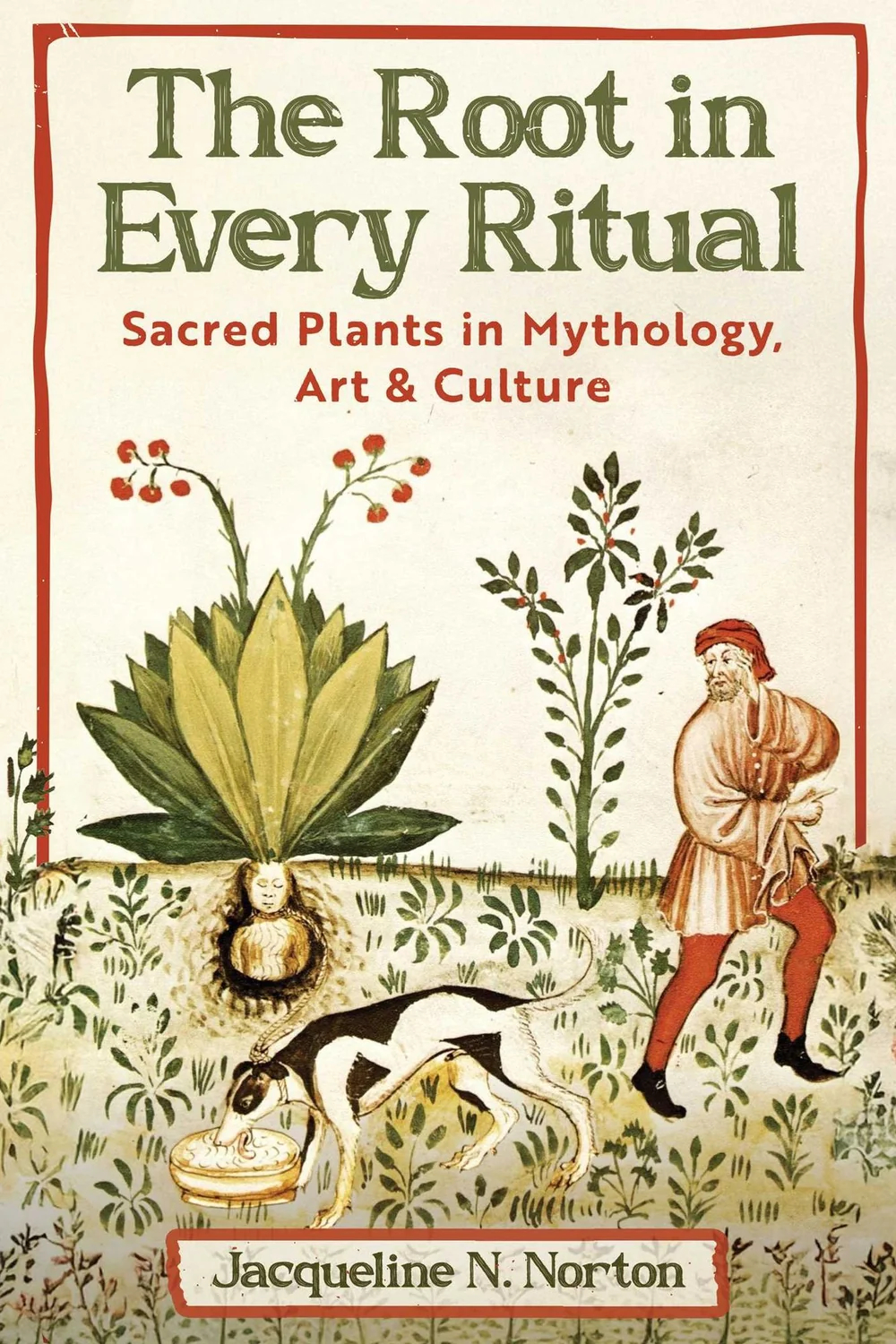
Jacqueline Norton’s The Root in Every Ritual is a beautiful book filled with art, plant photos, and very interesting information on nearly every page about a selection of sacred plants.
The introduction really sets the tone for the book, and this line in particular resonated with me: “Plants are not merely a tool but are kin—beings with spirit, agency, and memory.” This is a dearly held belief of mine when it comes to plants as well, so I felt a very quick connection to Norton’s text and felt I was going to really enjoy the book.
The book is divided into nine chapters, each one focusing on a different aspect of plants and their connections to life and death, love and fertility, transformation, luck…
One of the chapters, The Apothecary’s Secret, speaks on plants for healing. It must be noted that this chapter (and indeed, the whole book) is not a how-to on making tinctures, salves, poultices, or any other healing remedy. For that knowledge, other resources should be looked for elsewhere.
That said, learning about the history and mythology, the art, and cultural meaning of some my favourite plants gives more depth and meaning to their possible healing properties, and will ensure that my future uses of any of these plants will be more informed, careful, and have an extra layer of respect and understanding.
Every chapter, every plant, was really interesting and fun to read about—especially with colour photo plates and art—and so, to give an idea of what a reader might find, here are some very interesting things I learned about fly agaric (Aminata muscaria), the red mushroom with white spots that is so frequently depicted in fairytales.
• Siberian shamans used these mushrooms to induce trancelike states.
• Fly agaric is linked to Viking berserkers and may have played a role in their heighted aggression in battle.
• The Koryak people “ingested the urine of reindeer that had eaten A. muscaria in the belief that they could experience the effects of the mushroom more safely.
• The depiction of these mushrooms is often “synonymous with fairies, elves, and other mystical beings”.
• A warning that eating these mushrooms remains “extremely dangerous” for those without very extensive and practised knowledge.
Every plant written about in Norton’s book has this level of interesting facts, history, folklore and accompanying art and pictures.
For those wishing to learn more about sacred plants and connect them on a deeper level, this book is a terrific addition to any collection.
~review by Mara McTavish
Author: Jacqueline N. Norton
Destiny Books, 2026
Pp.: 374, Price: $29.99 USD