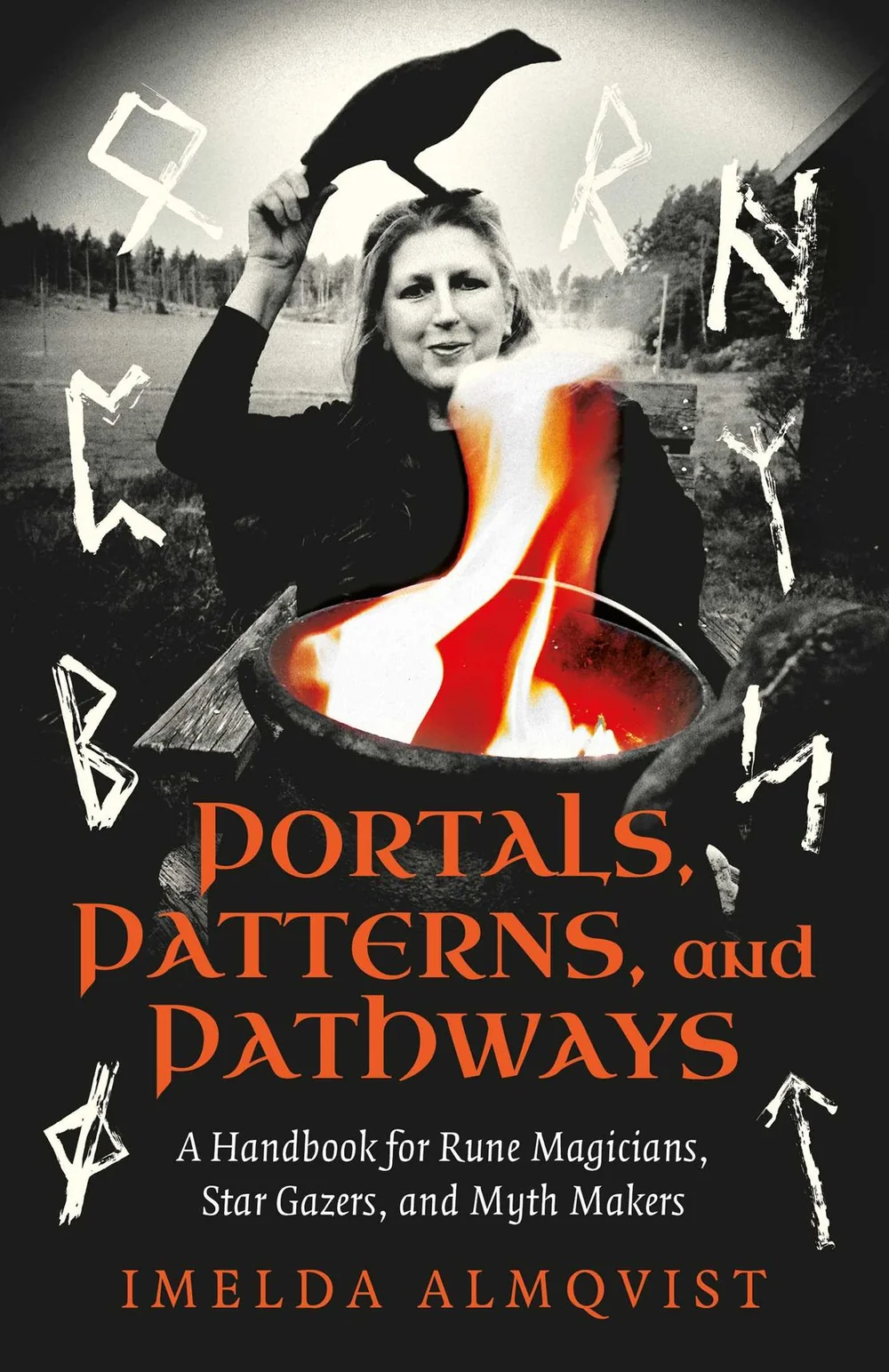
I've been reading Imelda Almqvist's online writing for several years now, and eagerly awaiting this release. It is far outside my normal magickal practices, but I know Almqvist's work is so well-researched and deep that I just couldn't stay away. It was a long dive and I loved every part of the swim.
So much about the runes (Elder Futhark) is linear -- from the way they are typically laid out to be read to the symbols themselves -- and in hindsight it seems simple to assemble them into different configurations. How did the runes become so stagnant? Almqvist plays with modalities all while remaining deeply grounded in the ancient traditions. In Portals, Patterns and Pathways, intuition is aligned with rigorous research and the reader is given exciting ways to move beyond the ordinary.
Although the reader is given a set of standard meanings and some basic instruction, this is no book for beginners! While I don't work much with the runes, I have a solid foundation in them, as well as astrology. For me, the bringing forward of the energy of the aettir into a feminine modality was refreshing and felt like a rebalancing. Ultimately, Almqvist is a runic animist, honoring each rune as its own entity, not just in relation to each other.
What's the big deal you might ask? Almqvist sees the runes in relationship with each other both via the aettir and within the circle. In this way, clusters and groupings of runes are viewed through connections, manifesting the Web of Wyrd. And yes, a literal spiderweb is present.
The reader is treated to a variety of mythological information, not just Norse, as well as an enchanting enumeration of the runes in modern context via both astrology and astronomy, and their uses in magic and healing. Almqvist prefers to use cosmology, "because it refers to a coherent belief system, often aligned with a particular location and ancestral tradition. A cosmology offers a cognitive map for understanding and navigating both this world and other realms." (p. 103)
Throughout Portals, Patterns and Pathways are activities designed to encourage your understanding of the runes and develop your facility of communication with them. We also wander through (short) discussions of the origin of writing, star patterns, alternate constellations, and many stories. My favorite comes at the end of chapter ten, The Runes and Old Norse Anatomy of Soul: In modern Western society we often use the word soul. How do you define your concept of soul? Attempt to write down a definition. When this is done, write down your own definition of spirit. How is it different from soul? (p134)
~review by Lisa McSherry
Author: Imelda Almqvist
Collective Ink (Moon Books), 2026
pp. 280