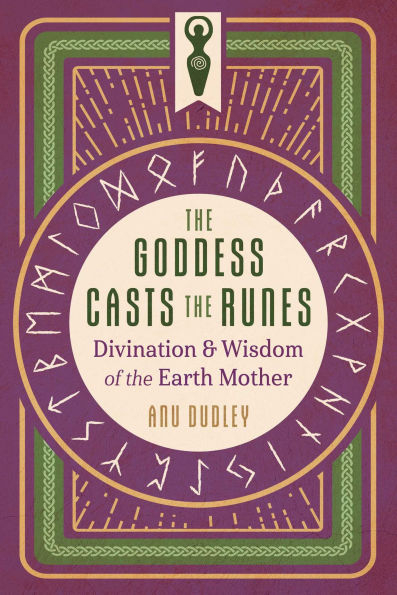
The Goddess Casts the Runes by Anu Dudley is a radical reimagining of the Elder Futhark runes, recasting them as originating in pre-Nordic Mother Goddess lore. In this eco-feminist perspective, the runes are plucked away from Odin, the male-oriented ideologies, and (later) Christian writers.
With their straight lines, the runes seem naturally aligned with energy we most often associate as masculine, and most writers seem to root their interpretations of the symbols with conquest, battle, and ownership. Dudly offers a new lens, one in which community, connectedness, and compassion are highlighted, reflective of the Mother Goddess, described as “the Divine Entity who created life and endowed it with strength, compassion, and wisdom (p 7).”
“The purpose of this book is to provide an ecofeminist, Earth-based perspective on the runes that takes into account salient principles of feminism, environmentalism, and the sacredness of the Earth as well as the archeological, mythological, spiritual, and etymological origins and significance of the runes. It reclaims the runes for the Mother Goddess, whose grace and power these ancient symbols were originally created to honor (p 3).”
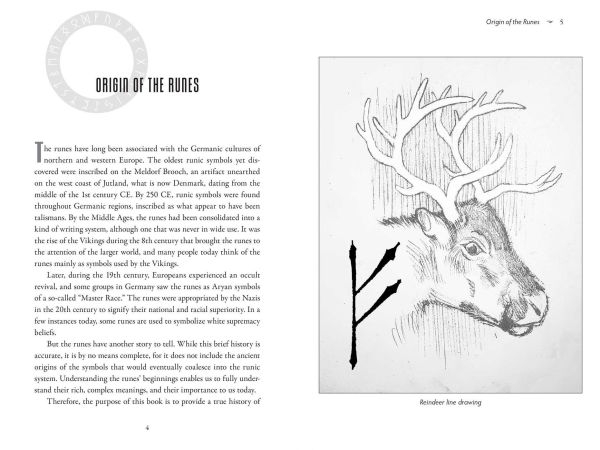
In “Part 1: Reclaiming the Runes for the Goddess,” Dudley offers her alternative for the origins of the runes in relation to the Mother Goddess. Odin "wins" the runes through his sacrifice, a mythological explanation for the shift from a worship of the Mother Goddess to a male dominated patriarchal culture.
“Part 2: Reading the Runes” takes the reader into the historical, spiritual, and mythological exploration of each rune in Dudley's eco-feminine perspective. The three Aetts of the runes are linked to the archetypes of Maiden, Mother, and Crone. Overall, the rune interpretations will feel very similar to traditional readings, but the how and where the Goddess is present in each interpretation is quite new. Even a bit bold. Dudley reframes the runes as part of a broader, more inclusive spiritual tradition tied to Earth, nature, and the divine feminine. For example, the rune Gebo describes how as “children of the Earth, we are natural givers.” From our gratitude of the world around us to our physical exhalation of carbon dioxide to plants, we are inherently giving creatures. This is tied into the traditional meaning of the rune as the “Marriage Rune”, where we are giving of ourselves to another.
I admit that I struggled with not trusting Dudley's scholarship sufficiently to agree that the runes came from a pre-Nordic matriarchal society, that felt like UGP, not knowledge. As well, I was disappointed that the only biology-based feminine values were represented.
Nonetheless, I recommend The Goddess Casts the Runes for anyone seeking to work with the runes in a way that steps outside of the traditional framework and reconnects them to the sacred cycles of nature.
~review by Lisa McSherry
Author: Ana Dubley
Destiny Books, 2025
pp. 128