Whether wars are raging over land, resources, culture or beliefs, nothing beats religious fervor as an animating force for violence. Would that be true if not for the dominance of my-way-or-the-highway monotheistic religions? Not likely.
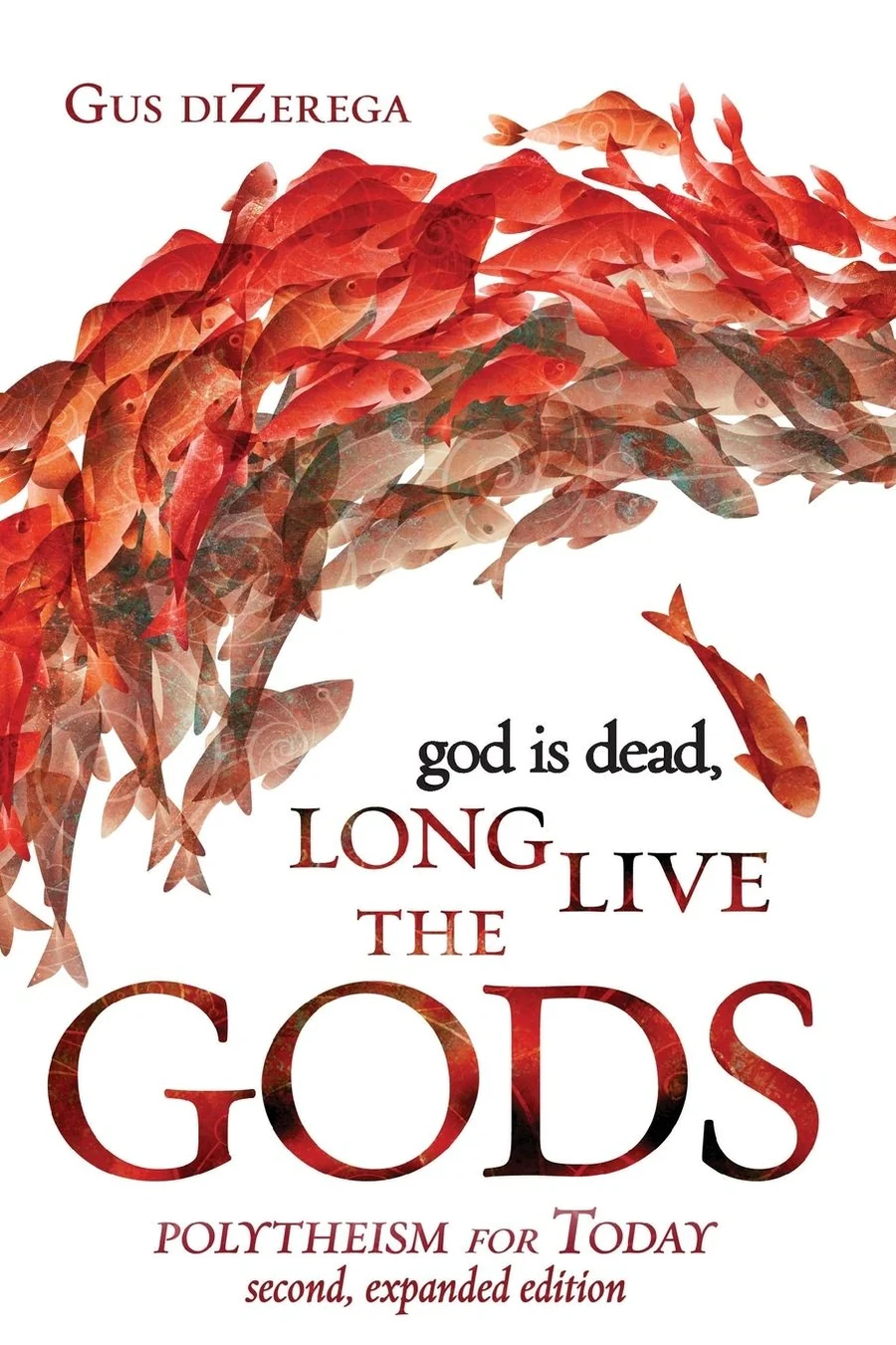
In God is Dead, Long Live the Gods, Gus DiZerega asserts that polytheism is both “the natural experience human beings have always had of the world of Spirit” and that “it is a much more accurate understanding of the world within which we live than the secularism usually considered the alternative to monotheism.”
DiZerega is a Wiccan elder and an erudite political scientist. His previous works include books about the 1960s, about the divine feminine, about democratic self-organizing. His new tome – it is dense and complex and impressive-- is a revised edition of a book he published in 2020 during the pandemic. The 2026 edition adds two new chapters, one on polytheistic religions and a timely one on evil from a polytheistic perspective. The publisher is Concrescent Press, a small pagan publishing house based in the San Francisco Bay area.
What makes DiZerega’s new book extremely engaging is the way he smoothly synthesizes historical, theological, scientific and sociological knowledge, peppered with stories from his own long and winding spiritual paths, from his days as a Berkeley grad student to his encounters with a wizard named Don Frew, to sweat lodges and vision quests, Brazilian healing circles and immersion in the African Diasporic traditions. This book is for skeptics, agnostics, fellow trekkers, anyone who thinks about why institutionalized religion is often such a plague.
The problems begin with what monotheism proposes itself to be. “Monotheists claim that all existence was created by a single deity,” DiZerega writes. “This creation was to further His divine plans, and these plans included demands people must obey, on pain of divine punishment. This deity claims it is omnipotent, omniscient, and good, and demands precedence over all other entities.” All of this makes monotheism an incredibly bold article of faith. And yet, at face value, it’s not all that believable.
Take Christianity, which has produced countless warring sects and sub-sects. The various institutions that have called themselves Christian are so diverse and theologically inconsistent that it’s as if they don’t even worship the same God. And even if they do, they don’t act like it. Heretics have been killing other heretics in the name of Christ since they got started.
Nor is Christianity unique. Among Muslims, the Sunni and Shi’a fight each other and have often persecuted the Sufi mystics among them. With the Jewish monotheistic sects, who’ve survived as marginalized minorities, the infighting has rarely led to inter-sect warfare. But the premise that land belongs uniquely to Jewish monotheists is what underlies the state of Israel’s genocide against people of a different God.
What a scourge monotheism has been, fueling atrocities while its adherents can’t or won’t agree about who or what God is. In the particular case of Christianity, the conflicting theologies are incoherent—DiZerega’s word—to the point of falling apart as history has progressed.
Here I want to note that DiZerega does not disparage past or present communities that coalesce around the monotheistic religions, let alone individuals (myself among them) who find meaning in the spiritual practices of monotheistic religions. Instead, DiZerega makes a point of acknowledging “the sacred also existing within the various Abrahamic traditions” because “a polytheistic perspective preserves what is best in the different monotheisms, explains what is worst in them, and harmonizes what is best with other religious traditions.”
DiZerega’s complaint is with the leaderships, the institutions, the fossilized theologies of monotheism. It is inherently incoherent when, for example, a religion posits a God who is merciful and also strikes down all his enemies; when such a God is “jealous” of other Godds the religion claims don’t exist; when God is said to be “perfect” in an “imperfect” world of his own making. It’s a mess.
Over the centuries, monotheism has led to a desacralization of societies, in part through what DiZerega calls the “death of allegory.” In Christianity’s early eras, an allegorical approach “allowed for avoiding a clash between scripture and observation of the natural world.” If the Bible says God created the world in six days and observation suggests something more akin to evolution, the “six days” can be construed allegorically, i.e. symbolically, as a span of time.
As Christianity spread, the invention of the printing press in the 15th century loosened the Vatican’s monopoly over the meaning of scripture. Then, Luther’s translation of the New Testament exposed Christian monotheism’s incoherence by allowing people to read the Bible themselves. Printing and translation led to more people reading and arguing over texts. Arguing led to factions solidifying around conflicting versions of literalism. The rise of scientific rationalism doomed the sustainability of literalism.
Yet, the early scientists were not out to disprove the “truth” of scripture. Scientists sought to study things in the material world by testing hypotheses and rejecting error and, as DiZerega tells it, they ultimately “abandoned all of their scripturally derived assumptions about the world except for distinguishing mind from matter.”
Alongside the physical sciences arose the social sciences. The latter produced a “secularization theory,” the prediction that religions would eventually fade out. Data shows it’s true that religious institutions are declining in participatory strength—apart from the disproportionate influence of movements such as the Christian Right. Consistently, though, large percentages of people in western societies--including scientists and self-described atheists--report having had paranormal or “spiritual” experiences. Common to the varied experiences is the sense of not being alone here in the physical realm.
Science is coming around to the “view that consciousness is in some sense a basic quality of the world” and that even simple organisms exist because they are in relationship with other beings with some type of consciousness. This starts to sound like animism—doesn’t it?—the view that all things possess a spirit or a soul. Or, as DiZerega puts it, that “biological and psychological individuality is contextual and relational.” From this premise, he concludes that “polytheism is in harmony with modern science, and with all forms of reported spiritual experiences,” though he acknowledges that it’s “not a powerful argument for the existence of different deities.”
Instead, he finds, it is challenging to prove the validity of polytheism because spiritual experiences are so varied. Some non-human entities appear as individual personalities, some not; some encounters occur spontaneously while others occur after prayer and petition; some deities appear cross-culturally while others are localized. What is consistent is that polytheists “encounter their deities in relationship” and by experience, rather than by sheer faith or by being told what to believe by authority figures.
DiZerega is humble in not claiming to have found the Truth with a capital T about whether the Divine is to be thought of and experienced as singular or plural. Where he lands, based on his own and others’ polytheistic experiences, is that what—and Who—is available to us is of “divine variety and complexity.” It is believable to say that the Godds are alive, diverse, and everywhere, always.
Highly recommended.
Reviewed by: Sara R. Diamond
Author: Gus DiZerega
Concrescent Scholars, 2026
346 pages, $29.99