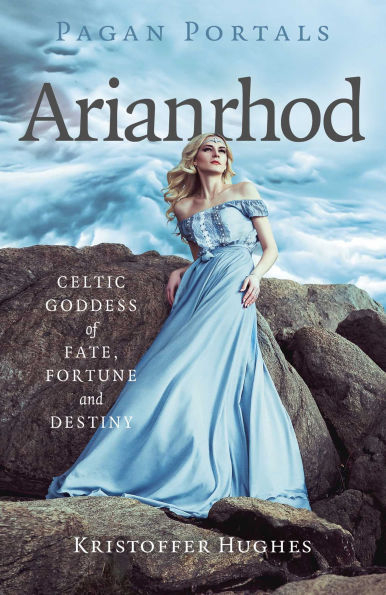
Arianrhod: Celtic Goddess of Fate, Fortune and Destiny by Kristoffer Hughes is the kind of book that makes the reader think. For the first two chapters, Hughes traces the appearance of Arianrhod in the Fourth Branch of The Mabinogion, the earliest collection of Welsh mythology, and argues for Arianrhod’s inclusion in the Welsh pantheon, not as a literary character but as a goddess in her own right, and indeed a goddess of major attributes and power. Hughes concedes that no evidence exists for any cult or temple or even statues or votive offerings to Arianrhod specifically, yet on the basis of magical or supernatural qualities associated with Arianrhod—and what he calls “apotheosis,” the elevation of a person or figure to the status of deity—Hughes argues that her recognition of a goddess by neopagans is to be taken as argument enough for Arianrhod’s deification. Hughes delves into Welsh linguistics and offers etymological analysis of the roots and variants of the name Arianrhod/Aranrhod to set the stage for a more in-depth critical reading of Arianrhod’s role in the story of Math, Son of Mathonwy in The Mabinogion.
Readers unfamiliar with Welsh mythology and with The Mabinogion in particular may find parts of this book somewhat esoteric, and Hughes’ argument for Arianrhod’s deification in particular a bit of a challenge. Presumably, though, most readers interested in a book like this will already have some knowledge of these subjects, and may well have an active practice of connecting with Arianrhod and have no trouble at all seeing her as a goddess, and will read this book in delightful anticipation of further insight and knowledge to her nature. And that all is entirely to the good. The ideal reader would have some familiarity with Welsh mythology, perhaps at least a reading knowledge of the Welsh language (though Hughes does provide translations of the extracts he cites), and some knowledge of comparative myth and religion. But this should not discourage any reader from following Hughes’ argument. It is not meant for the specialist, though the book could be read by scholars with profit. For my part, I make no claims to expert status on any of these issues; I don’t read Welsh and have only read relatively short excerpts from the text of The Mabinogion (in English translation). But what I was able to bring to the reading of this book is a fair bit of knowledge about comparative myth and religion, training in literary analysis, and the perspective of a reviewer who has read and reviewed a number of books in the Pagan Portals series—though this is the first book I have examined that deals with a Celtic and specifically a Welsh deity. All of that said, this book should by no means be regarded as inaccessible to readers who have little to no knowledge of Celtic mythology or specifically the Welsh pantheon and mythical tradition. As the series suggests, this book is meant to serve as an introduction, or a portal, to further exploration of Arianrhod and her significance as a figure of magic and power.
And so it is on that basis that I register my endorsement of the book: Arianrhod: Celtic Goddess of Fate, Fortune and Destiny was for me an enjoyable read. Though for the most part uninitiated in the mysteries of The Mabinogion, and of Welsh myth and lore more generally, I found Hughes’ philological and narrative analysis fascinating and revealing. For it is very much a book informed by Hughes’ status as a native Welsh speaker and as a practicing Druid. The book takes mythology seriously and Hughes proves himself a capable guide in aiding the reader’s understanding of complex Welsh concepts and textual nuances that would otherwise be inaccessible to the uninitiated and the non-native reader. So at the end of the day, while I do find at least some of Hughes’ argument regarding Arianrhod’s status as a goddess compelling, I am not entirely convinced that the argument is beyond critique—and yet, it is for this very reason that I am all the more stimulated to read more about the issue, and yes to read the text of The Mabinogion in full. In this light, perhaps, I am finding my own fate, fortune and destiny as a reader and as a writer shaped by the silver wheel of Arianrhod, whose magic and power work differently for different readers, be they skeptics or believers or just curious poets who appreciate the magic of myth on its own terms.
The book is recommended, and should appeal to neopagans, practicing witches, Celticists, folklorists, comparative mythologists, academics, poets, writers, and general readers alike. Also recommended is a reading of The Mabinogion for a fuller appreciation of the deep philological and textual analysis that forms much of the bulk of Hughes’ argument. (Perhaps a reading of the story of Math, Son of Mathonwy on its own would suffice, whether read before or alongside one’s reading of Arianrhod.) Arianrhod: Celtic Goddess of Fate, Fortune and Destiny could also be profitably paired with other books in the Pagan Portals series that deal specifically with Welsh deities, such as Kelle BanDea’s Modron: Meeting the Celtic Goddess, Danu Forest’s Cerridwen: Keeper of the Cauldron, and Jhenah Telyndru’s Rhiannon: Divine Queen of the Celtic Britons, all three of which I may attempt in next month’s Facing North.
~Review by Christopher Greiner
Author: Kristoffer Hughes
Moon Books, 2025
93 pages