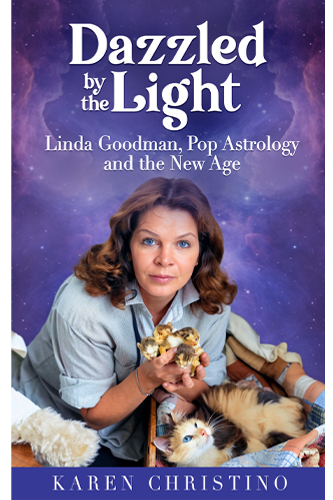
With her 1968 book Sun Signs, Linda Goodman took the publishing world by storm and launched the mass popularity of astrology that continues to this day. If you’ve ever been asked “what’s your sign,” thank Linda Goodman for making that line a cultural artifact.
Before Sun Signs, there had been a long history of public interest in newspaper horoscope columns; and, before that, astrological forecasting had been a mainstay of the popular almanacs that followed the invention of the printing press. But a thorough understanding of astrology was more of a fringe pursuit, something studied by occultists and other eccentrics, using a lot of math and jargon that wouldn’t appeal to the average, fairly educated person.
Linda Goodman put astrology on the American cultural map precisely at the time when the rest of the spiritual counterculture, sometimes dubbed the New Age movement, was on the rise. Sun Signs was the first astrology book to hit the New York Times bestsellers list. Before Goodman died in 1995, Sun Signs, Love Signs, and her other books had sold about thirty million copies. Google tells me that to date her books have sold over sixty million copies. No wonder the mass appeal of astrology continues apace, especially since the spread of astrology via YouTube, TikTok and the like.
But who was Linda Goodman (April 9, 1925 to October 21, 1995) and what was her life like? That’s what astrology historian Karen Christino set out to investigate and document, and she’s done it. Dazzled by the Light is arguably the definitive biography of Linda Goodman, and there’s no better writer and researcher to have written it. Christino is a long-time practicing astrologer and author of eight books, including one she published and we reviewed (in 2023) about the early 20th century astrologer Evangeline Adams who helped to legitimize astrology back then by fighting off court cases against herself as a “fortune-teller.” One scholarly text about new religious movements called Adams “America’s first astrological superstar.” Linda Goodman was the second.
Christino’s biography of Goodman begins with her birth name Mary Alice Kemery. In this incredibly detailed, exposition, Christino chronicles Goodman’s three marriages (at a time when that was rare) and at least one other long-term relationship; her four children plus another who died as a baby. Though Goodman’s books earned a fortune, her finances were a tangled mess, as was the estate she left behind for others to sort out.
Before she was famous, Goodman worked as a newspaper reporter, a radio host, and a speech writer. Sam Goodman was her third husband. She changed her first name to Linda while hosting “Love Letters to Linda,” a radio sow on which she read letters from soldiers to their loved ones.
Goodman was interested in astrology starting at about age 14. At about age 18, she learned to approximately calculate her own birth chart, from instructions in a book, which Christino thinks was probably something like Evangeline Adams’ 1927 book Astrology: Your Place in the Sun. Goodman’s love affair with astrology began sometime in 1964 or 1965 when Sam Goodman brought home for her a copy of The Coffee Table Book of Astrology.
Christino quotes Linda, who said that receiving that book began her “in-depth obsession with astrology… I spent eight months locked in the house studying the esoterics (the mystical part)….My husband… was ready to murder me. It was like the end of a fever when I finished. But I learned the value of knowing the stars and how it can help people.”
Husband Sam Goodman joked that Linda had stayed in a nightgown studying astrology twenty hours a day for a year. Astrology’s like that: captivating and even addictive. She began doing readings, but she found it took too long to prepare. Christino quotes Goodman to the effect that “to forecast a person’s future….an astrologer needs at least two weeks.” That was likely true in the days before computer software, when a chart had to be mathematically calculated and drawn by hand.
As public interest in astrology was rising, Linda wrote a book proposal. It was rejected by several publishers before a small press called Taplinger Publishing bought it. She completed the manuscript for Sun Signs in nine months.
What most interested me as I read Dazzled wasn’t so much Goodman’s personal life as what Christino writes about the overlap between Goodman’s astrology and her draw toward what else was going on in the late 1960s and 1970s New Age scene. Goodman “supported many tenets of 1970s New Age thinking, including the emphasis on self-realization and a personal connection with the divine.” The 1970s saw a groundswell of personal growth and spiritual exploration. Astrology was in the mix, along with alternative medicine, belief in reincarnation, Wicca, and environmentalism. Linda Goodman was in the thick of it. She recommended to others the writings of occultist Dion Fortune. She was heavily into ideas about reincarnation. Her astrology emphasized free will over fate, in sync with New Thought and New Age beliefs about “creating your own reality.” Christino quotes Linda Goodman, that “the purpose of astrology is to rise above your chart, to communicate with your higher self and make your own future. The future can be whatever you ordain it to be.”
No doubt, Goodman’s optimism is what made her astrology such a big hit.
Dazzled by the Light is essential reading for the expansion and preservation of history about astrology as a subject and as a cultural phenomenon.
~review by: Sara R. Diamond
Author: Karen Christino
Karen Christino, 2026
395 pages, $19.99