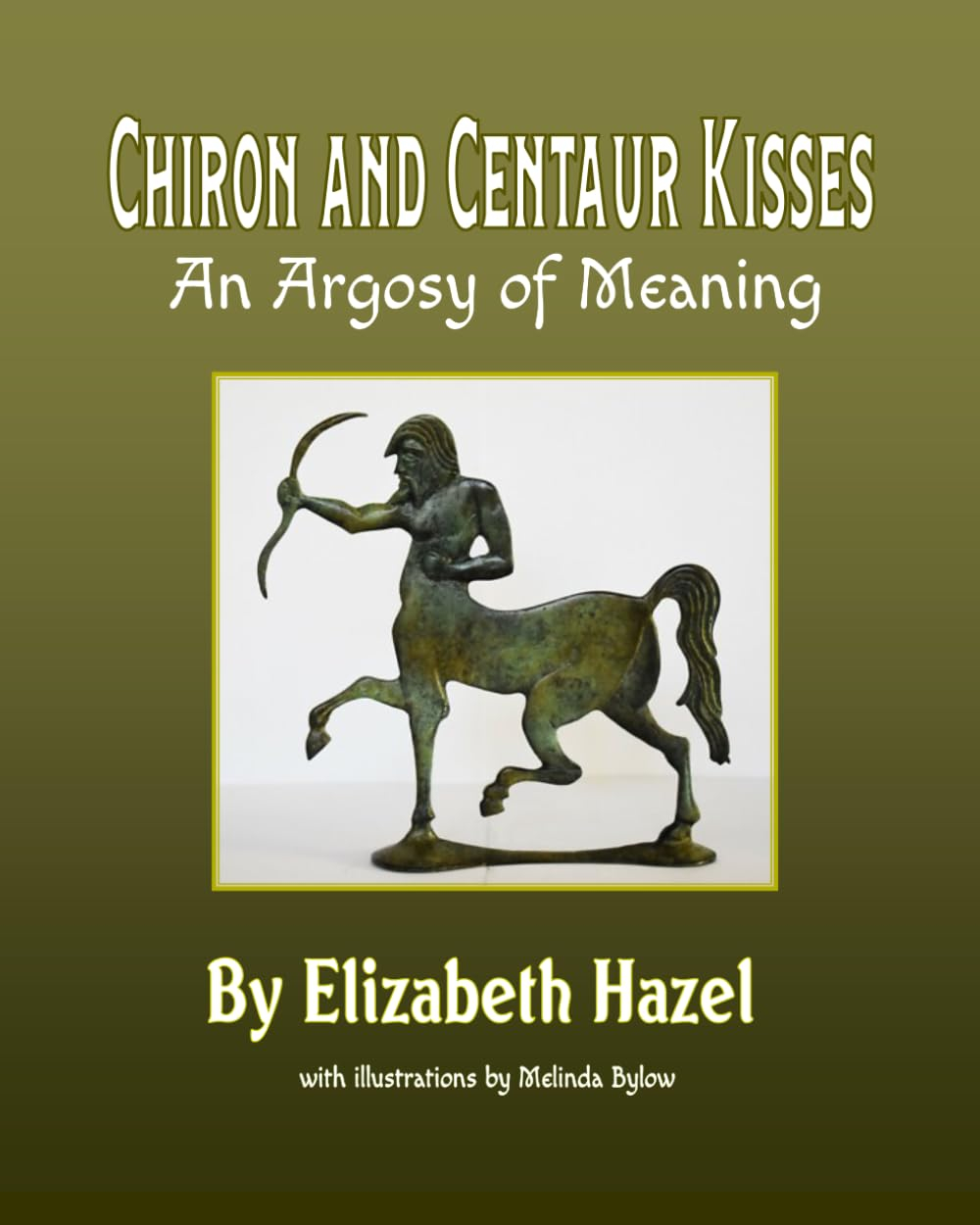
Our own Facing North reviewer Elizabeth Hazel has published a master work on the mythology and astrology of Chiron. This is the asteroid that was discovered in 1977 and was named for the mythic centaur and teacher of healing arts. Chiron is generally treated as symbolic of the “wounded healer” archetype, which in and of itself covers a lot of ground. What Elizabeth has done in her research for this book, though, is to greatly expand our understanding of Chiron, showing that it has a “rich treasure trove of meanings,” well beyond what astrologers have usually considered. This book is encyclopedic and, in my view, belongs on every astrologer’s shelf.
Chiron the asteroid has an orbit around the Sun of about 50 to 52 years. Next year, in June of 2027, Chiron will have its own “return” to the degree it was at upon discovery, making the publication of Elizabeth’s new book in 2026 very timely. By transit and for individuals, Chiron returns to its natal sign and degree when someone is about age 50 to 52. Astrologers treat the Chiron return as a mid-life transit when a person, consciously or not, returns to address life-long wounds. At mid-life maturity, someone may re-examine their own patterns of wounding and healing, hopefully integrating the kinds of painful lessons that never fully heal but that evolve into empathy and wisdom. Elizabeth devotes a large chunk of this book to the mythology of Chiron over swaths of time. Then she follows with a voluminous number and variety of delineated charts of famous people and events. The word “argosy” in the book’s subtitle means a large merchant ship, often carrying a rich cargo. That is, this book.
A major theme of the book is Chiron’s hybrid nature as a “living mythic character,” half human and half horse and like “a bridge between the Bonze Age pantheons and the Olympian pantheon of the Classical period.” Chiron is a “transitional character,” born from the union of Saturn and Philyra. Chiron’s mother rejected him at birth, thinking he was a monster when he was really a god.
Mythic Chiron is an individual character and also a representative of all centaurs, a “collective figure.” He is a teacher, a healer, a father. He’s got a gift for music. He is sometimes referred to as an “old man,” like Saturn, offering guidance. He’s a wanderer, who wound up in a role as king of the centaurs. The name Chiron comes from a root word kheir, meaning hand. Thus, the name Chiron means skilled with hands, “indicative of dexterity, talents, and special skills.” We know the word Chiron is related to the profession of chiropractic, meaning healing with hands. Elizabeth extends the notion of “skilled with hands” to include Chiron’s “role as a cultural intermediary, translator, negotiator and inter-tribal liaison.” Someone with a strong natal Chiron may be one who “wanders into a particular profession or leadership role without the formal education or training normally associated with the position.” In some stories, Chiron is an arranger of marriages, joining the hands of partners. Chiron plays bridging functions, like a shaman who enters into altered states of consciousness. Chiron’s own orbit is erratic. In charts, Chiron shows up in some unexpected ways. Again, that’s a major point of this book: Chiron signifies much more than just “wounded healer.”
In fact, as Elizabeth has worked with Chiron as a consulting astrologer for decades, she found early on that clients don’t necessarily respond to the usual ways astrologers have interpreted Chiron—because Chiron doesn’t stand alone in a chart. “Chiron is more than just a pretty face,” Elizabeth quips. In one client’s chart, she interpreted the relationship between Chiron and Mars to signify someone who doesn’t panic in a crisis, who has wandered into jobs without deliberate intention, and who has had jobs with a lot of driving involved.
The book’s chart examples include those of scientists, detectives, military professionals, criminals, musicians, influencers, world-changers, and “home-grown” religious figures. There are too many to name here, but they include musicians Linda Ronstadt, Bob Marley, Jimi Hendrix; lawyers Clarence Darrow, Morris Dees, Marc Elias, Ruth Bader Ginsburg; military minds Napoleon and Dwight Eisenhower; poet Diane di Prima; comedian George Carlin; Theosophist Helena Blavatsky; and even, more currently, the young man Luigi Mangionie, charged with the 2024 killing of a U.S. health insurance executive.
I zeroed in on the entry for Hannah Arend (1906-75), one of my personal heroines. Arendt was the exiled German-Jewish political philosopher and journalist, who theorized about how totalitarian regimes operate. While she was covering the 1961 Nazi war crimes trial of Adolph Eichmann for the New Yorker magazine, she mused about “the banality of evil.” That is a Chironic observation about mass suffering, to be sure. Arendt’s natal Chiron in Aquarius (conjunct her south lunar node) reflects her necessary flight from her homeland “which gave her unique insights into the traumas of statelessness, uprootedness, and non-belonging,” Elizabeth writes. “[Arendt’s] Chironic gift was her ability to analyze, describe and name these conditions through the lens of political philosophy.” Her natal Chiron “is at the apex of a Yod with Jupiter and Neptune (learning lessons first-hand and sharing wisdom with others) and analytical Virgo Moon.” In Arendt’s chart, Chiron also sextiles Venus in Sagittarius, “an aspect that heightened her perception of big picture issues and her ability to convey her conclusions in language everyone could understand.”
Like her entry about Arendt, each of Elizabeth’s case studies is thoroughly astrological and biographical. Elizabeth’s erudition across multiple disciplines beyond astrology shines through in this book.
She ends this grand work with a note about why it came to be. She writes that when she gave her first slide show about Chiron in 2015, she “was struck by an overpowering sense that the astrological Chiron needed rehabilitation in the astrology community….” because “Chiron is just as broad and complex as any of the outer planets.” More than just adding new Chironic keywords into astrologers’ toolkits, Elizabeth calls for “understanding the perils of tribalism that extend into the present, the historic roots of exclusion, oppression, disenfranchisement, and the erasure of history, whether personal or collective. Chiron must be embraced as more than just an indicator of wounds.”
~reviewed by: Sara R. Diamond
Author: Elizabeth Hazel
Kozmic Kitchen Press, 2026
451 pages