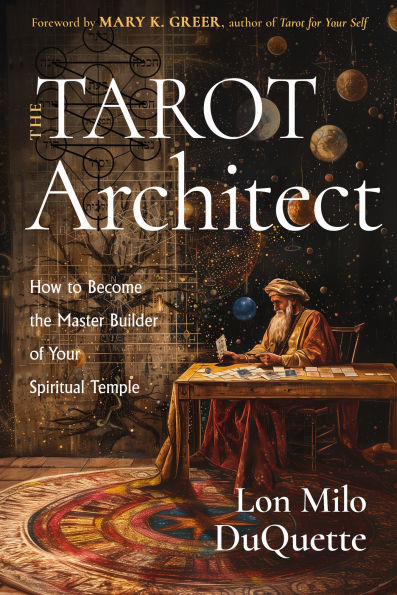
The Tarot Architect is a meditation practice curriculum and a set of metaphorical blueprints for building one’s sacred inner temple.
The exercises are a work for a lifetime, a gift from author Lon Milo Duquette and his 50-year practice of qabalistic tarot. I don’t know if I can praise this book highly enough.
The book begins with an endearing story of Duquette as a boy on a hot summer day in Nebraska. He was trying to build a house of cards on the living room carpet, which wasn’t easy. He had mixed results. Telling that story now in his elder years, DuQuette quips that something said to be built on a “house of cards” usually means its foundation isn’t solid. That’s to contrast the kind of house of cards DuQuette went on to learn to build, and what he teaches here.
His thesis is that Tarot is “a perfect working model of the cosmos.”
“Constructing a house of cards requires luck and an instinctual sense of balance,” he writes. “Once we are armed with just a modicum of understanding, any deck of tarot cards becomes a powerful magical instrument, a mirror to our own soul, a seamless reflection of the scaffolding of the mind of God, a miniature working model of the cosmos, an oracle of the gods.”
The blueprints DuQuette presents come from the magickal correspondences initiated by the Hermetic Order of the Golden Dawn beginning in the late 19th century. In her forward to The Tarot Architect, author and tarot master Mary Greer describes the Golden Dawn system as “seek[ing] to integrate numbers, astrology, color, sound, geometry, letters, the qabalistic Tree of Life, and more, with the supernatural realms and denizens aligned with the tarot.”
The Tarot Architect carries out this mission of integration. There’s no more adept person to explain it all than DuQuette (along with Mary Greer herself and the late Rachel Pollack, to whom the Tarot Architect is dedicated.) Readers may know DuQuette’s long list of books, including The Chicken Qabalah of Rabbie Lamed Ben Clifford; The Tarot of Ceremonial Magick, and most recently, a revised edition of The Magick of Aleister Crowley. DuQuette is currently the US Deputy Grand Master of the Ordo Templi Orientis.
In this new book, DuQuette explains how he got started with tarot. In 1974, he enrolled in the correspondence course offered by the the Builders of the Adytum (B.O.T.A.) mystery school, (part of the Golden Dawn heritage). B.O.T.A. requires students to color or paint their own set of 22 Trump cards. DuQuette spent two weeks completing each card, and when he finished, he writes, “I realized that I had undergone a true and profound initiation.” He says he now travels with two decks for his personal “magickal operations” and for reading for others. These are the Tarot of Ceremonial Magick, which he created with his artist-wife Constance in 1980, and the Crowley-Harris Thoth Tarot.
For practicing the exercises in The Tarot Architect, DuQuette recommends using any standard 78-card deck that includes 22 Trump cards and four suits representing Wands, Cups, Swords, and Disks, and to print (from his website) a set of line drawings used in the book, so as to be able to color them and create one’s own set. Some of the exercises also require use of a pitch pipe to determine musical notes. For his Court cards, he uses Knights (for Kings per the Waite/Smith deck), Queens, Princes (for Knights) and Princesses (for Pages).
Every standard deck, DuQuette writes, “is by virtue of its fundamental structure genetically linked to all other decks by a golden thread of the shared harmonies of numbers,” which are living entities. “Numbers are the programming code of the creation and continuity of existence itself. Qabalah is one name for this master code.”
Part 1 of the book lays the foundation with three essential working tools. First is the Tetragrammaton, the four-letter holy Hebrew Name for G-d. Next is the Tree of Life with its 10 Sephiroth. Third is the Cube of Space, a set of visualization practices beginning with the elemental, Hebrew Mother Letters (Aleph/Fool, Mem/Hanged Man, and Shin/Judgment or Aeon). The visualization practice is to install into one’s awareness three dimensions of space: above/below, east/west, and north/south. From there, the Cube of Space exercises involve using the seven Trump cards representing planets; and then, the twelve Trumps that correlate with zodiacal signs, to visualize the construction of an inner building with directional walls and angles. Lest this sound like too much, it’s not. DuQuette’s diagrams and step-by-step instructions make the exercises eminently doable.
In Part II of the book, he details the correspondences for each of the cards and introduces more dimensions of occult work, including attunement to sound. To chant vowel sounds while visualizing the Trump cards aligned with their respective directions, he recommends using a pitch pipe or electronic keyboard to find the right pitch. In his treatment of the Lesser Arcana cards, he reminds the reader of the first working tool, the 4-letter Tetragrammaton. The four suits each epitomize one letter of the Great Name, one of the four primary elements, one of the four Qabalistic Worlds, and Parts of the Soul.
Within each suit, he calls the Aces and Princesses the “elemental bookends of the Lesser Arcana,” similar to how the Fool and the Universe/World cards bookend the Major Arcana. He’s got a chapter on the 36 “small cards,” the nine numerical cards times four. In the Duquettes’ system, each of the small cards carries elemental qualities of its suits, as well as qualities of one of the Sephirot, one decan (10-degree portion) of a zodiacal sign. Each small card’s decan is also home to two of the 72 qabalistic angels which he calls “specialized executors” of specific facets of the four letters that form the holy Hebrew Name. These finer points get complicated. But DuQuette includes what he calls “Angel Stuff” and a reference to the “Goetia spirits” by way of reference for those who want to pursue it.
The book is like a little red schoolhouse for intermediate to advanced students of the occult. DuQuette generously packs this book with information, presented coherently. It is to be studied and applied.
In an Epilogue, DuQuette addresses the reader: “Now it’s fair for you to ask: ‘Is my house of cards finished?’” No, he says, he’s still working on it.
“For fifty years, tarot has been for me the only magical tool comprehensive enough to work exactly as advertised. It is my magic wand, my Holy Grail, my Excalibur, my shield, my temple, my filing cabinet, my dictionary, and my microphone. Tarot is the language I use to try to explain the universe to myself.” The house of cards he started so long ago – he hasn’t finished building it. “This book is my latest effort,” he says. Nor is his, or anyone else’s life, perfect.
“My house of cards is as fragile and unstable as anyone’s…. It’s enough for me to remember that each time my house of cards tumbles down around me it simply means there’s more work to be done.”
“I’ve accepted the job offer,” he concludes. “I hope you have too.”
~review by Sara R. Diamond
Author: Lon Milo DuQuette
Weiser Books, 2025
336 pp., $24.95