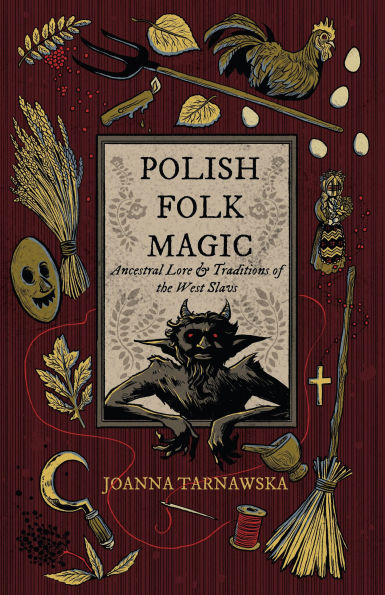
The most important thing to know about Polish Folk Magic is that the book is excellent. Whatever your reason for picking it up, it is worth your time and $20-25. Polish Americans, it is worth any tariff money you spend. Go - buy it! It's one of those books meant to be read, reread, and curated!
If you find long, pedantic, somewhat emotional reviews not to your taste, here is your time saver. Enjoy the extra book-reading time.
For people who like their book reviews a little juicier, I have more to say for a reason. My reason? I am a Polish-American witch. I grew up when the only acknowledgment of that part of my heritage happened only at Christmas and Easter. When I grew up, my Polish-ness had a less-than-ideal place in the American class hierarchy. We were blue collar, and in the very WASP community I grew up in, that somehow translated to "less."
When I converted to American eclectic Wicca in my teens, I never had that "coming home" feeling either. I had psychic abilities that weren't socially acceptable among "normal" people. At least in eclectic Wicca, I found people who sometimes helped me deal with them. In the US, Paganism tends to emphasize Scandinavian, Germanic, and English cultures. Even people from the British Isles have spoken of feeling somewhat sidelined. (Notably, the invisibility is still preferable to the slander directed at any non-white magical practice).
Now, on to what you need to know about why a book written by a Polish author matters so much to so many Polish-Americans. For those unfamiliar with matters spiritual and Slavic, a few points of context to follow.
Possibly most important: Slavic nations are not a monolith. Some cultural universals remain the same. Every culture has food mores and harvest celebrations. Seasonal cycles always come with seasonal observances. In many ways, the culture that bound the Slavic nations together was the Catholic Church. Even at the height of its power, the different Slavic nations all had a unique-to-itself Roman Catholicism. That tie was rescinded under Communist rule.
A book about Polish Folk Magic will look very different from a book about Russian or Ukrainian Magic. All Slavic countries had the Catholic Church and the Iron Curtain as mitigating factors in the evolution of their cultures. Yes, the similar climate and the cultural influences did lead to some similarities. Syncretic faiths and orthodoxy did find their own footholds. But even with some parallels, these cultures are not the same. Even the beloved dumplings - pierogi, varenyki, and piroshki - have subtle differences.
Second, Slavic people have been present in North America since the Civil War. Their presence increased during the 20th-century World Wars. The Iron Curtain added even further drastic changes to these cultures. The result of these historic conditions? As bombs destroyed villages, Slavic people left. Many came to the United States, looking for a way to have a life.
As these people came to the United States, they formed their own communities. Some came about because of the way American classism worked in the 1930s-1960s. Silent segregation was also a likely factor. The way my father (born in 1934) grew up was typical of a Polish-American upbringing. He attended Catholic schools that taught in Polish. All the businesses close to his parents' house were Polish. The language he heard on the streets of East Chicago, Indiana, was Polish.
That culture bubble came with the aforementioned social status and economic costs. It also led to a disconnect between early- and late-20th-century Polish immigrants. Those who came to the States after 1980 referred to their Polish-American counterparts as "farmers." These people kept old ways that their younger counterparts thought best forgotten. Those old ways included such celebrations as Harvest Home and folk Catholicism.
Most of Polish history remained, at best, a footnote in world history classes. Sometimes it wasn't even mentioned until the Holocaust came up. Unless you grew up in a Polish neighborhood, you didn't know that Tadeusz Kościuszko helped engineer victory in the Revolutionary War. If you heard of Frédéric Chopin, you either played piano or enjoyed the novels of George Sand.
It was common to walk into a public library, look for books on Poland, and find, at best, one book. Most public libraries had nothing. Even now, a search on Slavic culture in online libraries available to the public focus overwhelmingly on Russian immigrants, sometimes to the complete exclusion of any other Slavic country. The same holds true of books on Slavic Paganism. You might find a book or two, but the count stopped at two. Often, what was available in English was a hodgepodge of fairytale lore and "oh, that wasn't documented until the Church took over."
I, and others like me, have spent a lifetime navigating a field of Celto-centric and Germano-centric celebrations. We've seen Slavic gods, especially Perun, co-opted into white supremacist ideology. We've seen both inclusive and exclusive attempts to create magic-centered Polish communities. Mentioning feeling excluded after the fourth Calleigh-Middle Eastern garage rock band combo to mainstream US Pagans? Most generally met such commentary with silence. On some occasions, reactions to requests for inclusion outside that frame seemed proportionate to a rude biological deposit in the middle of a ballroom floor.
Polish Folk Magic gives so much more than relief to diasporic isolation. It offers a coming home. What Joanna Rarnawska provides is an animistic, syncretic worldview. Founded in roots both ecological and historical, it makes a belly-deep sense to those of us who often struggled with that sense of "split culture." The inclination to spiritual duality finally has an explanation. The understanding that the devil is far different from what we are told is a comfort. It is not the comfort of "it's safe now." It's the soothing that comes when a person is correctly explained to themselves.
There are some important differences from the author's lived experience. It may prove an odd filter for her to witness.
Rarnawska is a native Pole. Her lived experiences with land and land spirits will differ from those of her North American counterparts. I can't speak to interactions with invasive species in Poland. They have a decided ecological and spiritual impact Stateside. While Catholicism was the Christianity of late European immigrant classes, it takes on different forms in the US and Canada.
The land and spirits that Rarnawska knows best are in Poland. If you're not in Poland, you can't connect to Polish animistic spirits. You need to be there.
To experience connection to land, you have to connect to the land where you live. That does not mean that house spirits, such as the domovoy, don't appear close to home. Ancestors are not animistic and are thus more portable. (Rarnawska has a different view on animism than I do, and sees all spirits as animistic. Perhaps because I am a naturalized species on my own continent, I define it differently. I see animistic spirits as spirits that can't be removed from an environment without ecological disruption. The way I see it, most animistic spirits can't travel. But the ghosts of the human dead can, and often, the water supply remains just fine with or without the ghost.
It is an excellent book, and anyone interested in folk magic and global practices should read it. The chapter on egg-rolling alone has some exciting possibilities and techniques to explore.
Books on Slavic magic in English have slowly started populating occult bookshelves. Most still need to be special-ordered and rely on print-on-demand. Crossed Crow Publishers has gone to great lengths to retrieve books from obscurity and to bring new voices like Tarnawska's to light.
One quote stood out for speaking to the ancestral roots of Polish practices. "The magic of the common folk is never free from baneful work." Tarnawska highlights the impact of feudalism on Medieval Poland. She speaks to how oppression made such spells necessary for survival. She then points out that the world still has the same oppression, in new places. Necessity shaped the magic, and continues to give it form.
For those who have found their true paths in neopaganism, Polish Folk Magic opens important conversations about bioregionalism. Even if the cultural roots differ, environmental concern forms an ideological bridge. But for people like me, raised as an at-best Christmas-and-Easter Slav, Polish Folk Magic offers something much deeper: a sense of connection. An explanation of long-held intuitions and impulses. An answer to why "The wax for God and the wick for the devil" makes visceral sense.
This book is highly recommended, especially for people connecting to Polish folk culture.
~ review by Diana Rajchel
Author: Joanna Tarnawska
Crossed Crow Books 2025
266 pg. Paperback $24.95 US