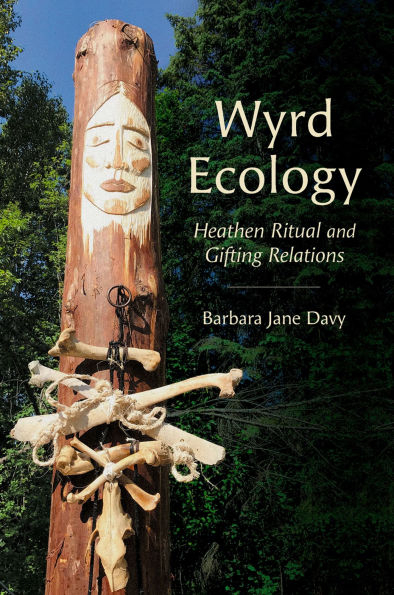
The popular image of the Heathen religious revival, even in academic circles, has been shaped by the American White nationalist and racist groups and the Eastern European anti-immigrant and “Volkish” nationalist movements. While these groups still exist and while the origin of North American Heathenry was in the Odinist and racist groups, Heathenry has grown far past these origins to become an inclusive and vibrant movement of neo-Paganism. Barbara Davy, a Canadian university professor and Heathen with a strong interest in intersections of religion and ecology undertook two years of participant observation in two Heathen communities in Ontario and the result was Wyrd Ecology.
She examines a number of facets of ritual practice and several distinct types of Heathen ritual through different lenses of ethics and theory. The broad chapter headings are Wyrd Relations, Becoming Ancestors, Procession of Reconnecting, How Pro-Environmental are these Heathens?, and From Here to There and Back Again. Each chapter has sections explaining meaning (of words like sumbel, wyrd and disablot) and developing the theme around discussion of specific rituals. She includes the survey that she ran with questions on demographics, community, economy, environment, religion/spirituality, and tables of results. There are also photographs of altars, and people in ritual garb.
This is a fascinating and very valuable work of ecological practical theology focusing on how ritual practices, particularly of offerings and gift giving, create and deepen identification with the natural world and relationships with it. By acknowledging the powers of nature, ancestors, land spirits and deities with gratefulness for their gifts which sustain our lives and then giving our own gifts to them, we create an ever-deepening ‘spiritual permaculture’ (not her term) in which what we draw from the Earth energetically returns to it and enriches it, to be fed to us in turn.
Throughout the book Davy is reflective, careful to quote extensively from members of the community when discussing different issues. The concluding chapter gives her the opportunity to open up about her biases as a Heathen studying her religious community, as a person looking into the practices of a community for evidence of ecological sensibility and the possibility of selection bias, theoretical issues around ritual performance and experience, and issues around inclusive Heathenry and the possible future development of the religious community. I found this reflection very fruitful.
There is description of details of ritual performance, but this is not principally a ritual handbook, just as the discussion of deities and mythology is limited. If that’s what you are looking for, look elsewhere. But for a deeper theological discussion, this is meat for thought and action. And it is a real pleasure to read something so substantial and grounded about modern Heathenry.
~review by Samuel Wagar
Author: Barbara Jane Davy
Oxford University Press, 2025
229 pg. Paperback £21 / $39 Can / $28 US