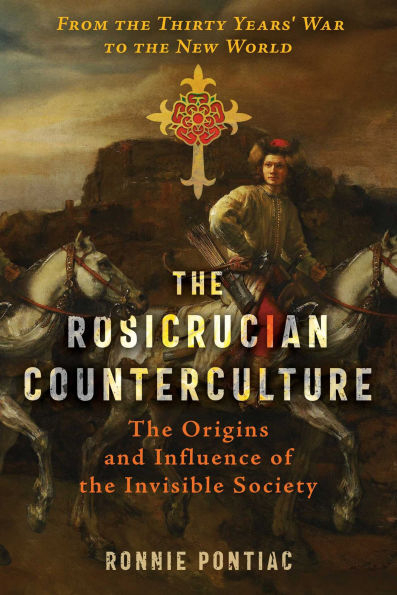
This book expands our understanding of the centuries-long intrigue over the origins of Rosicrucianism, the spiritual and counter-cultural movement that arose in Europe in the 17th century.
Much of what has been thought to be the origins of Rosicrucianism has been influenced by the work of British historian Frances Yates (1899-1981) and her book The Rosicrucian Enlightenment (1972). Yates wrote about how Renaissance era hermeticism – including Rosicrucian teachings – was key to the rise of Enlightenment era science which, tragically, later rejected science’s spiritual underpinnings. The “Yates paradigm,” as her work came to be called, posited that there was no real person named Christian Rosenkreuz who founded a secret society of mystics called Rosicrucians. Instead, as author Ronnie Pontiac describes Yates’ work, the Rosicrucian “movement was born from a loose-knit group of esotericists who were also social critics.”
Pontiac is a long-time scholar of countercultures and western esoteric traditions. In his youth, he was a research assistant to the venerable mystic-philosopher Manly P. Hall (1901-1990) at the Los Angeles-based Philosophical Research Society. Pontiac started his Rosicrucian research when Manly P. Hall gave him a copy of A.E. Waite’s The Brotherhood of the Rosy Cross, along with access to a PRS vault holding “artifacts of the history Waite wrote about.” Pontiac’s been immersed in this subject for decades. He writes in his new book that he’s a storyteller, not a Ph.D., but he’s being too modest.
The Rosicrucian Counterculture is Book 3 in a series about esoteric countercultures, the first being American Metaphysical Religion (2023) followed by The Magic of the Orphic Hymns (2023), the latter of which Pontiac wrote with his late wife Tamra Lucid. Pontiac and Lucid themselves are counter countercultural artists – Los Angeles-based rock musicians and documentarians. Pontiac’s also an astrologer.
The new book begins with Pontiac’s observation that recent academic scholarship--based on primary source material that Frances Yates didn’t have access to--sheds new light on historical figures who were at the center of Europe’s early modern counter-culture. Pontiac focuses to a large extent on three 17th century figures: Holy Roman emperor and occultist Rudolf II (1552-1612) whose royal court was a meeting ground for scientists, artists, and mystics; as well as royal couple Frederick V (1596-1632) and Elizabeth Stuart (1596-1662) who briefly ruled Bohemia and who were at the center of religious wars between Protestants and Catholics. Pontiac cites as one inspiration for his new book the work of Dutch literary historian Nadine Akkerman whose recent (2021) biography of Queen Elizabeth Stuart revises earlier caricatures of her as a lightweight and instead portrays her as a sophisticated political operator.
The Rosicrucian Counterculture can be read both as an intellectual history of an era and also as a kind of detective story. Pontiac emphasizes that by “counterculture,” he means currents not necessarily linked to a specific political viewpoint; a counterculture is broader and more enduring than politics. In early modern Europe, there was an esoteric milieu populated by a cast of characters – some, to this day, better known than others – experimenting with everything from astrology, to alchemy and the laws of science. They included Queen Elizabeth I’s court astrologer John Dee and his esoteric colleague Edward Kelly, Danish astronomer/astrologer Tycho Brahe, Bohemian Rabbi Judah Lowe, Robert Fludd, who authored of books about the harmonics of music and countless others.
Pontiac details how Rosicrucianism began with the circulation of “three little books,” whose authorships and initial publication dates aren’t definitively known. These were the Fama Fraternitatis; Confesio Fraternitatis; and The Chymical Wedding. The first, the Fama, published around 1614, was a manifesto announcing the existence of a secret brotherhood with an agenda to share wisdom about esoteric arts such as alchemy and magic, with the goal of reforming both science and religion. Pontiac compares the Fama to a “late twentieth century zine,” put together by “a group of friends whose contributions reflected various levels of involvement and intent.” Between 1614 and 1623, over 400 books and pamphlets about Rosicrucianism were published. That’s a phenomenal output for the times.
Plenty of this material made its way across the Atlantic to north America. One of the many stories Pontiac tells is that of German mystic Johannes Kelpius and his followers who in 1694 arrived in a new town called Philadelphia. They brought with them “a mélange” of Rosicrucianism, German pietism, the theosophies of Paracelsus and Bohme, and an early manuscript of a book that wouldn’t be published for a hundred years,” called The Secret Symbols of the Rosicrucians. Kelpius and, after his death, another mystical leader from Germany, Conrad Beissel, Pontiac writes, “have sometimes been credited with bringing Rosicrucianism to America,” but a generation earlier, the Connecticut Colony was founded by Rosicrucian John Winthrop.
The stories and names in this book are voluminous, and thankfully the book includes a lengthy bibliography and a good index. This is a reference book to keep and consult with.
Toward the end of the book, Pontiac writes of Rosicrucianism’s persistent influence in politics and culture in Europe--even if symbolic-- as in the word “bohemian,” stemming from Bohemia as a nexus of where science and mysticism were not seen as contradictory. When counterculture poet Allen Ginsberg visited Prague in 1965, he was crowned King of May by the university students, just three years before the Soviet Union rolled in with its tanks and crushed the liberation movement known as Prague Spring. Decades later, in 1989, as the USSR fell, the Velvet Revolution “liberated the people of what had once been called Bohemia.” Countercultural moments drive the cycles of history. Pontiac writes of the irony of Rosicrucianism. In its heyday, it “combined the mystical metaphysics of the Renaissance with science’s confidence in the human ability to learn.”
Yet Rosicrucianism opened the door to the materialism and scientism which soon found natural philosophers leaving behind “first alchemy and astrology and then the soul, the afterlife, and the gods,” to become known as “scientists.”
The story’s not over, though, Pontiac concludes, as in our times, the artifacts of almost all historically known countercultures are available to us online. “As we take the long view of history, we can see how small groups of dedicated people with innovative ideas have put into motion events that changed the world.”
~review by Sara R. Diamond
Author: Ronnie Pontiac
Inner Traditions, 2025
232 pages, $22.99