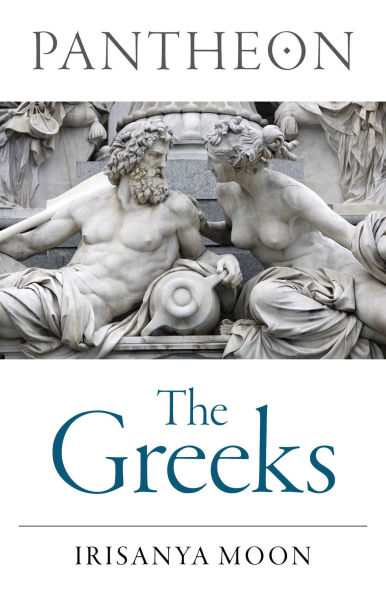
Pantheon: The Greeks by Irisanya Moon presents as a detailed and encyclopedic reference book that introduces readers to the history and mythology of the Greeks. The book is longer and more scholarly than Moon’s past books (190 pages including an appendix of terms and recommended reading list as well as endnotes and a bibliography). I have reviewed a number of Moon’s books (including her books on Aphrodite, Iris, Artemis, Circe, and Gaia—all Greek and all featured in the present book), and the chief difference that stands out between Moon’s earlier books and this one is the comprehensiveness and engagement with the primary source material. Pantheon: The Greeks is an impressive addition not only to Moon’s own growing bibliography but also to books available on Greek history and myth as such.
The book is divided into two parts, with the first part including seven chapters on topics ranging from history and mythology to religion and ritual, cosmology and cosmogony, celebrations and festivals, and a fascinating chapter on Greek magic. Part two contains two chapters dealing more specifically with the Greek pantheon, and these chapters include comprehensive entries on not only gods and goddesses but also heroes and monsters, daemones, nymphs, and other figures mentioned throughout multiple sources on Greek mythology. Moon also provides discussion on engaging with these many figures from a devotional aspect for personal practice. All in all it is a concise yet comprehensive review of Greek history and mythology, and will appeal widely to pagans and others interested in learning more about the Greeks.
“With so many beings and figures in Ancient Greek myths,” Moon writes, “it becomes clear how the concept of deity interacted with the world on many levels. Every part of life had the influence of the mystical and magical, and thus every part of life could be blessed and known as divine” (173). Indeed, such is the value of a book like Pantheon: The Greeks, as it aids the reader not only in gaining information about Greek history and mythology, but it places the information in a meaningful context, which is how that pantheon can color and enliven our relationship with the world today, the human and the divine.
Why read mythology? One answer is that a mythological imagination can be a powerful cognitive tool for understanding complex character motivations and relationships that unfold in an increasingly complicated cultural and geopolitical world stage. Another reason for gaining a mythological mindset is the depth and nuance that it adds to one’s perceptual stance to that world, and as it concerns one’s daily interactions with others, both intimate and mundane. It is simply the case that humans stand only to gain understanding, and perhaps even wisdom, the more that we can expand our horizons of perception—and poetry and myth absolutely hold the power to aid in that expansion. So at the end of the day, Pantheon: The Greeks is recommended not only for its comprehensive content and logical organization of complex material, but also for its intimate engagement with the myths, figures, and stories—and, yes, odysseys—of one of the most poetically complex people to whom we in the Western world especially owe so much of our understanding of the mysteries of the cosmos and the unfolding human drama within it.
~review by Christopher Greiner
Author: Irisanya Moon
Moon Books, 2025
pp. 216, $18.95