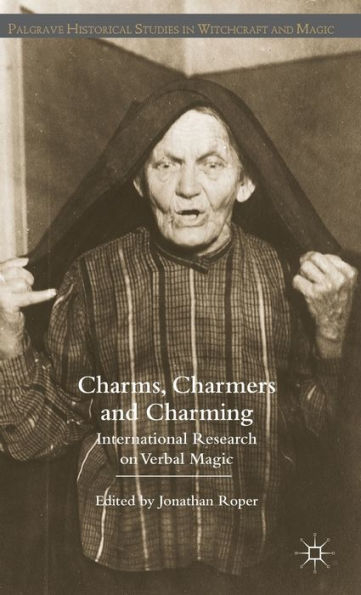
Well, Hell. This absolutely splendid collection of research into folk magic charms, the characteristics of wise women and cunning men (hint, a lot more like Granny Weatherwax than the cozy neo-Pagan fantasy), and the roles of charming, cursing and protection magic in folk cultures across Europe (principally – two non-European pieces) is expensive. I got my copy when Palgrave was having a sale, and I am very pleased that I did – go to your local university library and read it.
There is a strong focus on Eastern and Northern Europe, with chapters on Finnish magic, Hungarian, Swedish, Slavic in general, the Mari people, Russian, Slovenian, Estonian, Lithuanian and Latvian, Serbian, and Georgian, as well as four chapters on English charms and one each from Malagasy and Malay sources. A mixture of theory and close textual analysis of charm collections and each of the nineteen chapters has a helpful bibliography for follow up.
I found several of the chapters particularly useful to me; Laura Stark’s “The Charmer’s Body and Behaviour as a Window Onto Early Modern Selfhood” which details the creation of a scary public persona by Finnish folk magicians (tietaja) as part of their power, T. M. Smallwood’s “Conformity and Originality in Middle English Charms”, Andrei Toporkov’s “Russian Love Charms in a Comparative Light”, and Ulrika Wolf-Knuts’ “Charms as a Means of Coping”. There is a good deal of range here, and other readers will pull more from some of the other scholarship.
This is a very valuable addition to my library, as a monolingual magician. Some of the sources cited are in English (and less expensive) but the folklore of Eastern Europe has not been widely translated. Collections like this one are very helpful in broadening our horizons.
~ review by Samuel Wagar
Author: Jonathan Roper editor
Palgrave Macmillan UK, 2008
294 pg. Hardbound £122 / $227 Can / $163 US