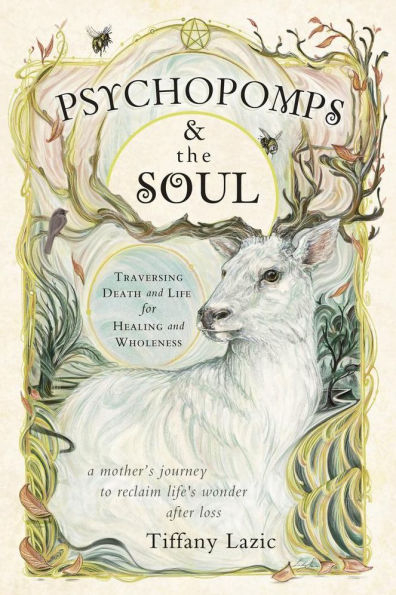
This book centers on a nearly unknown and long-forgotten topic — psychopomps — entities who aid souls along the paths of the dead into the afterlife. What happens at death is the Great Mystery, and it has been deeply considered and written about around the globe for aeons. Soul guides were a common feature in many cultures in the ancient world, but the regional lore faded in Western societies after the spread of Christianity. It is Lazic’s intent to “update their résumés…to enlist their inestimable skills in modern application.” (pg 4) The author decided to reclaim these guides during the recent pandemic of 2020-2021, and supplements her text with knowledge from her work as a psychotherapist as well as personal experiences.
The text is organized into four sections. Part I: Seeking the Light is an overview of multi-cultural beliefs about death and the soul’s passage to the afterlife. The author provides a collection of stories and myths that explain human mortality from many cultures, not just Western mythologies. The early development of theories about the soul and death rituals and funeral rites add to the global picture. Historic “book(s) of the dead” from Egypt, Tibet, Greece, the Mayan culture, Christian tradition, and others are considered and followed by a list of contemporary books on dying. There are more resources available than expected, particularly for those in the pagan tradition. Part I concludes with a ritual for honoring Light and Darkness.
Part II: Embracing the Grays describes the key themes, roles and attributes of soul guides. Psychopomps are go-between entities and depending on the culture, may be gods, angels, or deities that reside at the cross-roads. This is an incredibly valuable section of the book, as these various spiritual entities are sorted into seven distinct types that operate in different fashions in a range of cultures as transitional figures. In Chapter 13, the author provides thematic tips for interacting with each group of psychopomps.
Part III: Fleeing the Dark shifts to framing a psychological dark-to-light transition for individuals struggling with shame and trauma onto a path of psychological wholeness. It begins with an overview of the DSM and childhood trauma assessments. This section delves into steps that are taken as the individual confronts emotional burdens and transitions into a state of authenticity. Tibetan bardos are leveraged for the healing path at the end of this section.
Part IV: Living Full Spectrum provides a basis for working with liminal experiences, the psychological healing transition and the end-of-life journey. Chapter 22 presents a toolkit for those who act as psychological psychopomps — death midwives or death doulas who support those ready to cross, and counselors assisting patients with the psychological healing process. The author incorporates dream work, rituals, and Tibetan lokas. Rituals for assuming the mantle of a psychopomp and functioning as one are included. The end matter includes appendices and a bibliography.
On page 263, Lazic writes “I’m sure this has not been an easy book to read. It certainly has not been an easy book to write.” No, it wasn’t an easy book to read; two people died as I was reading it and another became seriously ill. This is a tough topic to approach, but this book offers invaluable information.
Lazic affirms that the book is about you (the reader) and your relationship with yourself and the Great Mystery of life and death. The author shares personal experiences throughout the book that parallel the information given in each section. The reader participates in the author’s process. This is an effective way to develop a deep connection between author and reader, but I must admit, as a person struggling with the grieving process, I struggled to cope with the author’s difficult experiences at the same time.
Nevertheless, I would highly recommend this book. As far as I’m aware, there’s nothing comparable in respect to the coverage of multi-cultural psychopomps and the well-defined categories that the author has created for understanding the differences in how these deities function in the space in between the here-and-hereafter. Equating the trauma healing process with the life-to-death transition process was surprising, but it is a valuable contribution for those in the consulting-healing fields as well as for those who may be working (or wish to work as) death doulas. This is a fascinating book as well as an invaluable reference text for its coverage of an inexcusably forgotten topic that touches everyone.
~review by Elizabeth Hazel
Author: Tiffany Lazic
Llewellyn Worldwide, 2025
325 pages
Please see our other review, here.