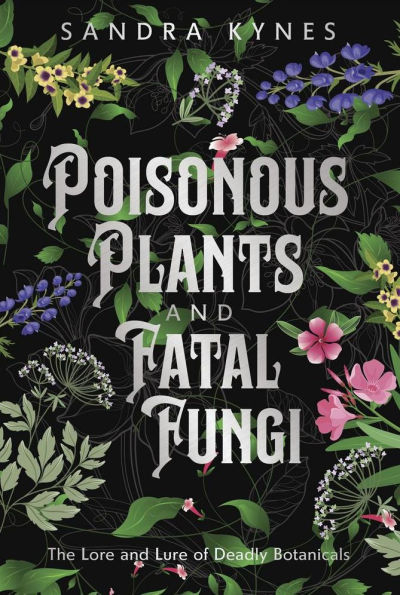
I want to start this review much as Sandra Kynes does the book, with a warning: Poisonous Plants and Fatal Fungi is not a how-to of poisoning, nor will it give you recipes or even photo identification of the plants and fungi discussed. Best practice would be to find official identification guides or, even better, work with the folks who have made the knowledge of these plants and fungi their entire business. They’re out there and generally very happy to share what they know.
On to the fun stuff!
The introduction and first five chapters of the book give a short but succinct overview of botanical terms, and some very interesting history about the use of plants. While you can simply dive right in and start reading about the individual plants, I recommend the introduction and the history as jumping off point as it gives the rest of the book some background.
I decided to start by looking up the plants and fungi I am familiar with, just from growing them purposefully in my garden, and from the other things I let grow in my garden because weeding isn’t fun for me.
My first stop in the book was daffodils. I’ve never been tempted to eat a daffodil, and after reading that “[a]ll parts of these plants are toxic, especially the bulbs” I am even less tempted – who knew these lovely flowers, with their cheery little yellow heads bobbling in the early spring breeze, could be so deadly! The history that Kynes follows up with is a fun read: Greek literature features daffodils in the abduction stories of Persephone and Europa; the flower is associated with death cults “such as the Eleusinian Mysteries of Demeter and Persephone”; and they “carpeted the legendary Elysian Fields”. There have been historical uses of daffodil bulbs for healing, where Chapter One’s “It’s All in the Dose” section is a good thing to keep in mind (but honestly, unless you are very practised and knowledgeable, this is not a good area to try DIY health solutions at home). Currently, there is medical research into certain properties of the daffodil possibly being useful for cancer and Alzheimer’s treatment.
I’ve gone over this single plant rather lightly here, the book is far more detailed and entertaining, and so is every piece on every plant. There is interesting lore and history, along with some truly eye-opening information about the toxic effects of quite common plants that many of us enjoy and even plant on purpose!
As a fun and informative read, this is a great book to pick up, and the chapters are short, as are the individual plant and fungi descriptions, so you can dip in quickly and learn a lot of really interesting facts.
Definitely a book I recommend, and one I’m going to re-read!
~review by Mara McTavish
Author: Sandra Kynes
Llewellyn Worldwide, 2025
pp.: 288, Price: $19.99 (USD)