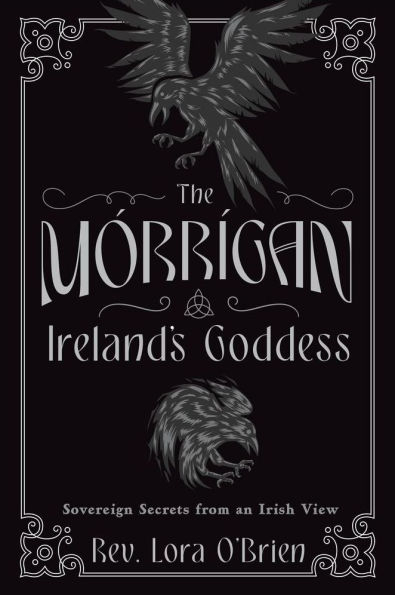
Author Lora O’Brien is a priest and practitioner of indigenous Irish magic and spirituality, and she’s also the founder of the Irish Pagan School. Her new book The Morrigan: Ireland’s Goddess: : Sovereign Secrets from an Irish View teaches devotees of the Morrigan how to ground their devotion in the study of Irish mythology and folklore. This book is a work of sacred scholarship.
O’Brien writes that her “deep dive into the historical and mythological foundations of the Morrigan isn’t just about understanding an ancient goddess; it’s about uncovering layers of history, culture, and belief that have shaped her stories over centuries.” The original stories of the Morrigan live in ancient manuscripts, requiring what O’Brien calls “literary archaeology” in the context of Irish culture and history.
Why does devotion to the Morrigan require scholarship? O’Brien explains that “primary sources give us the closest we can get to unfiltered access to how the Morrigan was understood in her own cultural context…. The Morrigan is not just a ‘war goddess’ or a ‘sovereignty goddess’; she’s a complex figure that can only be fully understood through a multifaceted lens.” She’s also a goddess whose name has had many spellings and many meanings, spanning centuries. The Morrigan is associated with war, sorcery, and prophecy. She has appeared in animal form, often as some type of a black bird. She has appeared as a young woman and as an old woman. She is “a quintessential representation of shapeshifting within Irish mythology…allowing her to navigate both this world and the Other with ease,” O’Brien writes. Her multifaceted nature, though, does not make her a stand-in for other Irish goddesses. O’Brien is intent on dispelling the tendency, which she finds common in New Age circles, to conflate the Morrigan with other deities.
“Is Danu the Morrigan? This may be one of the most common questions I get asked,” O’Brien writes, “and I genuinely struggle to deal with the Neopagan obsession with Danu. She is not the Irish mother goddess. There is no one specific Irish mother goddess.” Is the Morrigan a war goddess? Yes and no. Much of the Morrigan’s mythology is about battles, but “physical battles are sort of representative of all the other things she is concerned with and active in because in her day, that’s where it all played out.” Historically, warfare has been “a complex tapestry woven with threads of societal norms, political ambitions, tribal loyalties, honor and spiritual beliefs.” Warfare in the historical Irish context hasn’t been limited to soldiers fighting each other on battlefields. For example, cattle raids were also a form of warfare, with cattle as currency representing not just material wealth but also honor and retribution.
The Morrigan doesn’t embody one single theme, nor is she necessarily a singular entity. She appears sometimes as a “class of beings referred to by a variety of names that seem interchangeable.”
Given this complexity, then how would a practitioner begin to work with her? And, why? O’Brien cautions that what she hears most often when people start working with the Morrigan, is that “everything turns to shit.” Old patterns and tendencies may “come to a head in a dramatic and unavoidable way as is often the case.” The Morrigan, she writes, “will walk right through your unconscious mind and, over time, push all those buttons you’ve been studiously avoiding and all of the ones you didn’t’ even know you had.” This is a Goddess of battle, prophecy, change, shadow, sovereignty and empowerment, “all of which are not exactly sunshine and roses.” The Morrigan is not for the faint-hearted but for someone wanting to dive deep into the uncharted terrains of their inner being.
And, what is a Goddess anyway? O’Brien addresses this question in her chapter on Building a Relationship. She turns to Jung’s theories about the dynamic forces called archetypes which help to “explain that deities in various cultures are powerful symbols rooted in human biology and psychology that help us navigate life by embodying both stability and change, linking us closely to the natural world.” Deities are neither a figment of the human imagination, nor are they not a figment. They are autonomous and they also dwell in symbiotic, communicative relationships with human consciousness, individual and collective.
How would one know if one’s drawn to the Morrigan, and vice-versa? O’Brien lists the ways. One might start having dreams linked to themes of battles, sovereignty, or transformation. One might have the feeling of being watched or followed when no one is “really” there. One might have unusual, repeated encounters with crows and other corvids. For those who are drawn to the Morrigan, this book is a treasure trove of exercises, suggestions for offerings, and devotional acts.
O’Brien also offers the story of how she herself became a devotee of the Morrigan. I’ll leave most of the details for readers of this book. In brief, the tale involves the terror O’Brien felt when her baby nephew came down with a life-threatening illness; then a long climb into the womb of a cavern near a home she had recently bought “by accident;” a prayer into the darkness; a miraculous healing for her nephew in exchange for a vow O’Brien made to “get the information out there,” about the Morrigan.
This Rev. Lora O’Brien has done, with meticulous research and the story-telling prose of devotion, for the Irish people and for all others interested in Ireland’s Goddess, the Morrigan. This is a book of information and inspiration, to read and return to.
~review by Sara R. Diamond
Author: Rev. Lora O’Brien
Llewellyn Worldwide, 2025
283 pp., $21.99