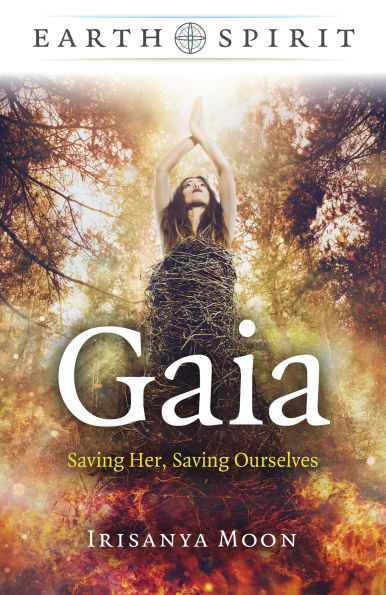
Irisanya Moon’s Gaia: Saving Her, Saving Ourselves may be read as a companion volume to her other book in the Earth Spirit series, Honoring the Wild: Reclaiming Witchcraft and Environmental Activism. Both books address the matter of cultivating earth-based awareness and eco-spirituality in the face of the climate crisis. While neither book is framed as overtly philosophical, both do share basic philosophical and ethical assumptions: that the Earth is a sacred, living ecosystem (and indeed a living deity if only metaphorically and mythically conceived as in the case of Gaia); that humans exist not as isolated, separate lifeforms but as organismically integrated members of the biosophere; that activism matters and may take various forms both mundane and mobilized; and that the cultivation of a personal relationship with the living Earth is vital to nurturing and sustaining all of these connections. Said more simply, both books drive home the point that being truly human means to live in conscious awareness of our intimate connection with the natural world—Gaia, the biosphere, the living ecology, however we phrase the connection.
Gaia reads like many of Irisanya Moon’s other books: it introduces a goddess, including the myths and stories and songs that have portrayed her through the centuries, and provides ritual exercises and magical meditations aimed to help the reader to cultivate a more intimate, personal relationship with the goddess. Gaia is in at least one respect special. Unlike other deities like Aphrodite or Artemis or Circe or even the Norns, Gaia is not only a goddess, but is in fact the mythical embodiment or personification of the Earth itself. A book like this one is useful in providing a mythical context and figure for a profoundly ethical project: stimulating the reader towards a moral valuation of the ecosphere in the interest of aiding its recovery, or at least of slowing its further degradation. The fact is that the Earth is in very bad shape right now—and humans just can’t seem to find enough or clear enough cause to effect the truly radical, systemic and cultural change that is needed to stave off the ecocide that is perpetuated on such an incomprehensibly massive scale both in micro-actions (ordinary people’s daily lifestyle acts) and macro policies (industrial and governmental structures of power imposed upon all the peoples of the world).
So, yes: the problems are huge, the threats are real, the solutions are seemingly nowhere in sight save utopian fantasies and Age of Aquarius optimism. I don’t mean to be flip about the seriousness of the planetary crisis or the very real and noble efforts on the part of those individuals and groups who do actually care about the life and integrity of the Earth, many of whom work very hard with many of the organizations mentioned in Moon’s book (e.g., 350.org, Earth Day Network, Extinction Rebellion, Environmental Defense Fund, Greenpeace, Rainforest Alliance, Sierra Club, The Nature Conservancy, etc.). But it really is hard to overstate the extent to which most ordinary individuals do feel helpless and hopeless and find the prospect of restoring the Earth to health and vitality a fantastic proposition. If the point of this book is to serve as a reminder to those already converted that they are not alone and that others care, then certainly I could say that its purpose has been served. Perhaps it is useful for some even in the pagan community to have an additional metaphorical or mythical anchor for their thought and for cultivating their relationship with the living Earth. I don’t see the harm in that, but I also think the main emphasis should always be on the ethical program and the philosophical underpinning that can make activism not only more thinkable but more effective and meaningful in practice.
I do think it is useful to think in metaphorical and mythical terms about very large and complex philosophical problems, such as the degradation of the ecosphere and the increasingly bleak outlook on any prospect of long-term sustainable change for the planet as far as human life on it is concerned. Philosophical points like the Gaia hypothesis are made somewhat less abstract by conceptualizing the Earth as a mythical being and a deity with whom one can cultivate a real and meaningful relationship. Devotional practice and caring for the Earth is made more tangible insofar as one can find evidence of Gaia’s divinity not only in the totality of the natural world but in the character and complexity of the divine nature which Gaia as a loving goddess embodies. “Taking action to help Gaia,” Moon writes, “turns a relationship from a thought experiment into a partnership” (61).
In the final analysis, Gaia is a very readable and relatable book, which can be profitably paired with other books on the subject (two important titles come to mind: Aldo Leopold’s A Sand County Almanac and David Abram’s The Spell of the Sensuous: Perception and Language in a More-than-Human World, as well as other books in the Earth Spirit Series, especially David Sparenberg’s Confronting the Crisis: Essays and Meditations on Eco-Spirituality and Julie Brett’s Belonging to the Earth: Nature Spirituality in a Changing World). It should definitely be read in tandem with Moon’s Honoring the Wild. Both of Moon’s Earth Spirit books include useful bibliographies and websites for further exploration of the concepts and issues addressed.
The book’s strongest point, in many respects, is that it offers a specifically Reclaiming lens through which to examine the ecological, spiritual, and activist dimensions of Gaia. Recalling Moon’s other books, Gaia pairs two key points of the Reclaiming compass: devotion to the Mother Goddess (with Gaia being the archetypal Mother Goddess in every sense of the phrase) and an engaged commitment to eco-feminist principles (which Moon contrasts later in the book with the “white supremacy” model). Those principles, in short, are a felt recognition of the vast and intricate independence of all living things, and the ethical responsibility that follows from that recognition. Moon identifies this element of worship and devotion: “The thing to think about is that if Gaia is Mother Earth, then you are always in Her temple” (63). In claiming that in caring for Gaia, we care for ourselves, Moon sets forth the essential environmental ethic of the Reclaiming tradition—a tradition that is made devotionally relatable through honoring the wild in Gaia, and in honoring that sacred wildness in each of us.
“Gaia,” Moon writes, “is a being that offers us grace and comfort, even in the darkest of times. She is a being who created the conditions for our arrival and our experience as humans. She is a goddess of all and a goddess of birthing the necessary unknown” (76). Gaia, then, is not only the Great Mother Goddess. She is the sustaining breath and embodiment of the sacred Earth in all its biodiversity, majesty, and grandeur. Good reading for a very good cause. It really doesn’t get more serious than finding pathways and thought patterns to improve the conditions of life for all beings on the planet, human and nonhuman and everything that breathes in between: Gaia, in a word.
~review by Christopher Greiner
Author: Irisanya Moon
Moon Books, 2023
112 pp., $12.95