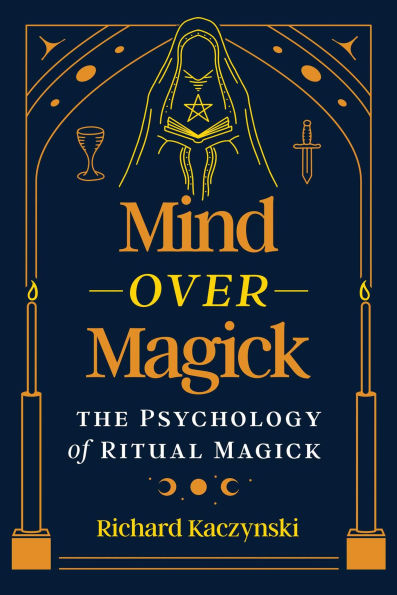
Is magick an art? A science? Is magick partially or mostly psychological, or is it something else? It would be hard to think of someone better suited to taking on these questions than Richard Kaczynski. He’s a social psychologist and statistician, grounded in academic research. He’s also a lifelong student/practitioner of western esotericism. He’s the author of perhaps the definitive biography of Aleister Crowley. For more than thirty years, he’s had what he calls a “split personality” as a “skeptical scientist” and a “freethinking practitioner.” Mind Over Magick is a must-read about the mutually supportive interplay between psychology and magick.
Up front, Kaczynski emphasizes that he is “not saying that everything about magick is psychological.” He writes that “[t]here are also social, cultural, anthropological, and religious aspects as well as nonscientific matters of faith or experience.” The aim of Mind Over Magic isn’t to pronounce psychology as a superior means to understand magick. It is to “explore the transformative practices of magick as reflected in psychology research.”
The book begins with an autobiographical chapter. Kaczynski grew up in suburban Detroit in a home and nearby woods full of things that went bump in the night. He reveled with his siblings over ghosts and apparitions, sensing “something inexplicable about the world.” As a kid, he spent a lot of time in the basement working his way through the magickal rituals found in Israel Regardie’s tome, The Golden Dawn. He researched the occult. He joined pagan groups.
When it came time to pick a college major, he thought psychology would help him better understand how magick works. But he was quickly disappointed to find that academic psychology considers the paranormal to be pseudoscientific bunk and occultists to be not too far off from nutty conspiracy theorists.
He deftly shifted his focus to social psychology and statistics, as these fields “addressed measurable behavior.” His Ph.D. advisor told him that a thesis on metaphysical beliefs and experiences would be a “career killer.” He proceeded anyway. For his dissertation (which I’d also love to read someday) he studied “behaviorally committed participants in the occult.” He found that questers – people whose “belief system involved actively learning and seeking new experiential insights” were the people most likely to have had a “transformative religious or spiritual experience.”
This is fascinating for anyone pursuing an occult path. It means that living a life of questing is a key to how magick works. Questing not just any old way but questing as humans evolved, as pattern-seeking animals.
In Mind Over Magick, Kaczynski summarizes what is known about the human brain, beginning with patternicity. We evolved with the ability to quickly assess environmental dangers, including over time, as in knowing what foods to avoid to stay alive. The human brain groups objects and uses contextual clues to shape expectations. We perceive meaningfulness even between unrelated things, a phenomenon called apophenia, which includes factors such as enhanced attention, vivid imagination, and hallucination-proneness. Apophenia isn’t abnormal; in fact, it’s “extremely common in clinically healthy individuals.”
I want to mention here that Mind Over Magick includes 74 pages of citations, both to social science journals and to occult works. The footnotes are readable as a side text to the book’s careful weaving of scientific and magickal knowledge. The book also has lots of graphics illustrating psychological phenomena, line drawings and photos of occult symbols and tools, particularly from the Golden Dawn and Thelemic traditions. This book is serious, and seriously fun to read.
Where magick and psychology intersect has everything to do with daily magical practices and rituals. Whereas a routine that’s a habit may be performed non-consciously, a magickal ritual requires “being mentally present.” A ritual involves three characteristics: 1) a “predefined sequence of words and actions, marked by formality, rigidness, and repetition;” 2) drawing on “a larger system of symbolism;” and 3) “The ritual actions are causally opaque,” meaning “not connected to the goal in an obvious cause-effect way.” Magickal practice involves all three of these. “From simple daily exercises to elaborate group rituals,” Kaczynski writes, “magick tweaks the magician’s consciousness to facilitate encountering the numinous…Understanding the psychological processes that drive or enhance a ritualist’s practice will help maximize the payoff of your magical practice.”
Kaczynski details some basic daily magical rituals such as saying grace at meals while reminding oneself of one’s True Will; recording one’s experiences in a magical journal; yogic breathing; meditative movements, and savoring, “pausing to enjoy a positive experience.” He cites studies showing the positive brain effects of long-time, daily meditation. For example, a 2021 published study called “Rhythmic Chanting and Mystical States across Traditions” found that 60% of subjects across 33 countries reported having entered a mystical state while chanting. “Those who experienced mystical states also scored higher in focus, altruism, and religiosity; ecstasy, peace, and tranquility; and feelings of ineffability.” The finding held true whether the chanting was vocal or silent, solitary or in groups.
Currently, work on the psychology of happiness incorporates a term coined by Aristotle long ago: eudaimonia, meaning to have a purpose in life. Practices of questing heighten one’s sense of purpose which is not so much about seeking pleasure as it is “potential-centric: striving to become the best version of ourselves.” Kaczynski situates eudaimonia in terms of Aleister Crowley’s occult approach: “namely, using the tools of magick to discover one’s True Will, and then using those same tools to accomplish it.” Kaczynski concludes that “through the practice of magick, we seek and experience the divine in the world, as well as our own inner divinity.”
~review by Sara R. Diamond
Author: Richard Kaczynski
Park Street Press, 2025
344 pp., $24.95