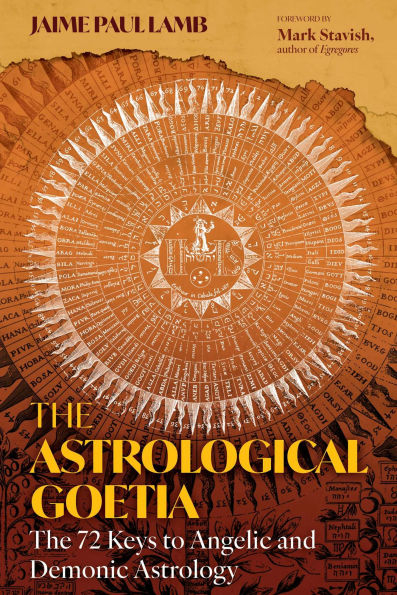
This is a book about quinary astrology, a practice within western esotericism. Quinary astrology is based on a division of the zodiacal wheel into 72 five-degree arc segments, each corresponding to 72 angels with mystical symbolism derived from the Qabalah, paired with 72 demons described in the grimoire called the Ars Goetia which is part of five books comprising the Lesser Key of Solomon. This book will be especially appreciated by people who love books as objects of art; Inner Traditions has published the Astrological Goetia as a stylish hardcover, something to treat with the reverence that’s due.
Where this system comes from, and how it’s used are well-explained in about the first 50 pages of the Astrological Goetia. Author Jaime Paul Lamb is an occultist and astrologer steeped in traditional and magical astrology. The bulk of the book is a Reference Guide to the 72 Angel/Demon pairs corresponding to each 5-degree quinary from 0 degrees of Aries through the final degree of Pisces, followed by brief chapters on how to use the system in natal, electional and horary astrology and in the making of talismans. At the end of the book, there’s a handy glossary of terms used.
This book is not for beginners. It’s highly specialized and geared for the “traditionalists” among occult practitioners. The bio on the book jacket identifies Lamb as having studied with Hellenistic astrology expert Chris Brennan; with Christopher Warnock, who has revived and sustained the practice of astrological magick; and with Mark Stavish of the Institute of Hermetic Studies. Lamb teaches astrology with Stavish’s institute. Lamb has written prolifically about Freemasonry, including a book titled Myth, Magick, and Masonry.
Generally, astrology divides the 360-degree zodiacal wheel into twelve 30-degree signs. Some traditional astrology divides the 30-degree segments further into 10-degree decans, based on ancient Egyptian astronomy. Quinary astrology, Lamb writes on his website, “incorporates elements of Babylonian and Hellenistic astrology, Qabalistic angelology, and Solomonic demonology into one unified and cohesive system. Each quinary is presided over by an angel and a demon who bestow their influence, attributes, and significations on any planet, part or angle found within its cusps.”
The quinaries are “somewhat of an astrological mystery,” Lamb writes in the Astrological Goetia. A quinary covers a five-day period of time. These “quinarian weeks” were alluded to in a third-century BCE Babylonian document. The quinaries “would appear to be the Babylonian cousins of the Egyptian decans,” which like the decans were associated with distinct images.
I found most fascinating Lamb’s discussion of the number 72 which, he writes, “is frequently encountered in the context of both astromythology and astrotheology” and which “figures prominently in qabalistic literature and in the Solomonic grimoire tradition.” Numerous mythologies and religions, Lamb writes, make reference to 72 angels, demons and jinn.
Seventy-two is significant for many reasons, including in regard to the astronomical phenomenon called the precession of the equinoxes. “Due to the imperceptibly slow gyration of earth’s axis, the vernal equinoctial point precedes by 1 degree approximately 72 years.” In a period of 2,160 years—which some people call an Age—the equinoctial point precedes through the 30 degrees of a zodiacal sign; and over 25,920 years the equinoctial point returns to its starting point in what is called a Great Year.
Astrologically, as in modern astrology, Lamb notes, 72 is also the number of degrees between planets when they form an aspect called a quintile. “This aspect, which inscribes a pentagon in the ecliptic, is evocative of the five-petalled rosette traced by Venus over the course of her synodic period (583.92 days) and, thereby, alludes to the Venusian archetype in its myriad forms, such as the Sumerian Inanna, The Akkadian Ishtar, and the Greek Aphrodite.”
All of this exquisite symbolism supports what Lamb says is the “primary purpose of this book:” to establish quinaries as a “practicable delineation technique,” though not just for any type of astrology. Because the quinaries have a “decidedly magical patina,” they are well-suited to magical operations. The five-degree segments can be seen to bear an influence on any planet or angle in an astrological chart, whether that be a chart to “elect” an auspicious time for an action; a chart for an optimal time to make a talisman; a chart in horary astrology, cast for the moment a querent presents a question to an astrologer; or a person’s birth chart.
For example, the planet ruling the rising sign in a birth chart is considered the general chart ruler. Looking to the precise degree of the rising sign places it in one of the five-degree quinaries. From there, one derives the angelic ruler of the “rising quinary” which “exerts an especially powerful influence pertaining to the native’s physical body, temperament and character.” This is one of many ways to make use of quinaries in chart delineation.
What’s clear is that the mission of this book is to advance and enhance the (re)integration of astrology and magic.
~review by Sara R. Diamond
Author: Jaime Paul Lamb
Inner Traditions, 2025
260 pages, $29.99